A guide to choosing between the two moped license routes, based on the languages available in the prefecture where staff will be placed
Newspaper scholarship students, technical intern trainees, specified skilled workers — organizations increasingly find themselves supporting foreign staff who need a moped license for commuting or delivery work. When that license comes through directly determines when they can start work and how quickly their life in Japan stabilizes.
Since the reform of October 2025, this decision can no longer be left to the individual. Choose the wrong route and the license can be delayed considerably.
This article sets out the numbers and the steps a host organization needs in order to decide.
Note: this information is current as of September 2026. Rules, available languages, and fees change. Always confirm with the police or licensing center in the prefecture where the test will be taken.
[Start here] Neither route involves a driving test
First, the point most often misunderstood. Getting a moped license involves no practical driving test. That is true whether you get a new license at a licensing center or convert a foreign one.
License conversion normally requires a skills confirmation (an actual driving test) in addition to the knowledge confirmation. But when the application is for a moped license, no skills confirmation is required. The moped safety course is not required either.
👉 "Avoid conversion because the skills confirmation is hard" does not apply to mopeds. If a moped license is all that is needed, what matters is the pass rate, the available languages, and the number of steps.
The two routes to a moped license
New license at a licensing center |
Moped via license conversion |
|
Written / knowledge pass rate |
58.7% |
42.8% |
Driving test / skills confirmation |
None |
None |
Moped safety course |
Required (Japanese only) |
Not required |
Available languages |
1 to 5, depending on the prefecture |
20 languages |
Bookings needed |
One, for the test day |
Document review and knowledge confirmation (same day or separate days, by prefecture) |
Waiting time |
Within a month in many areas |
1 to 3 months in some areas |
Home-country license |
Not needed |
Required (plus three months' stay after issuance) |
👉 The deciding question is whether the person can sit the written test in their own language in the prefecture where they will be placed. If they can, the new-license route wins on pass rate. If they cannot, conversion — available in 20 languages, with no skills confirmation and no safety course — is the more realistic path.
[Most important] Available languages differ by prefecture
This is the point most often overlooked, and the one that causes the most misunderstanding.
Support for 20 languages has been rolling out nationwide since June 2024, but that applies to the written tests for Class 1, Class 2, and provisional licenses, and to the license conversion knowledge confirmation. The moped written test is decided by each prefecture and is handled separately.
Tokyo (Metropolitan Police Department, updated 11 May 2026)
Class 1 / Class 2 / provisional, and the conversion knowledge confirmation |
20 languages |
Moped written test |
5 languages (English, Chinese, Vietnamese, Nepali, Burmese) |
Small special vehicle license |
Japanese only |
Those 5 languages are available on weekdays at the Fuchu, Samezu, and Koto test centers. The other 15 languages are offered on set days (Tuesdays at Fuchu, Wednesdays at Samezu, Thursdays at Koto).
👉 Staff whose first language is Vietnamese, Nepali, or Burmese can take the moped written test in their own language in Tokyo.
The neighboring prefectures are different
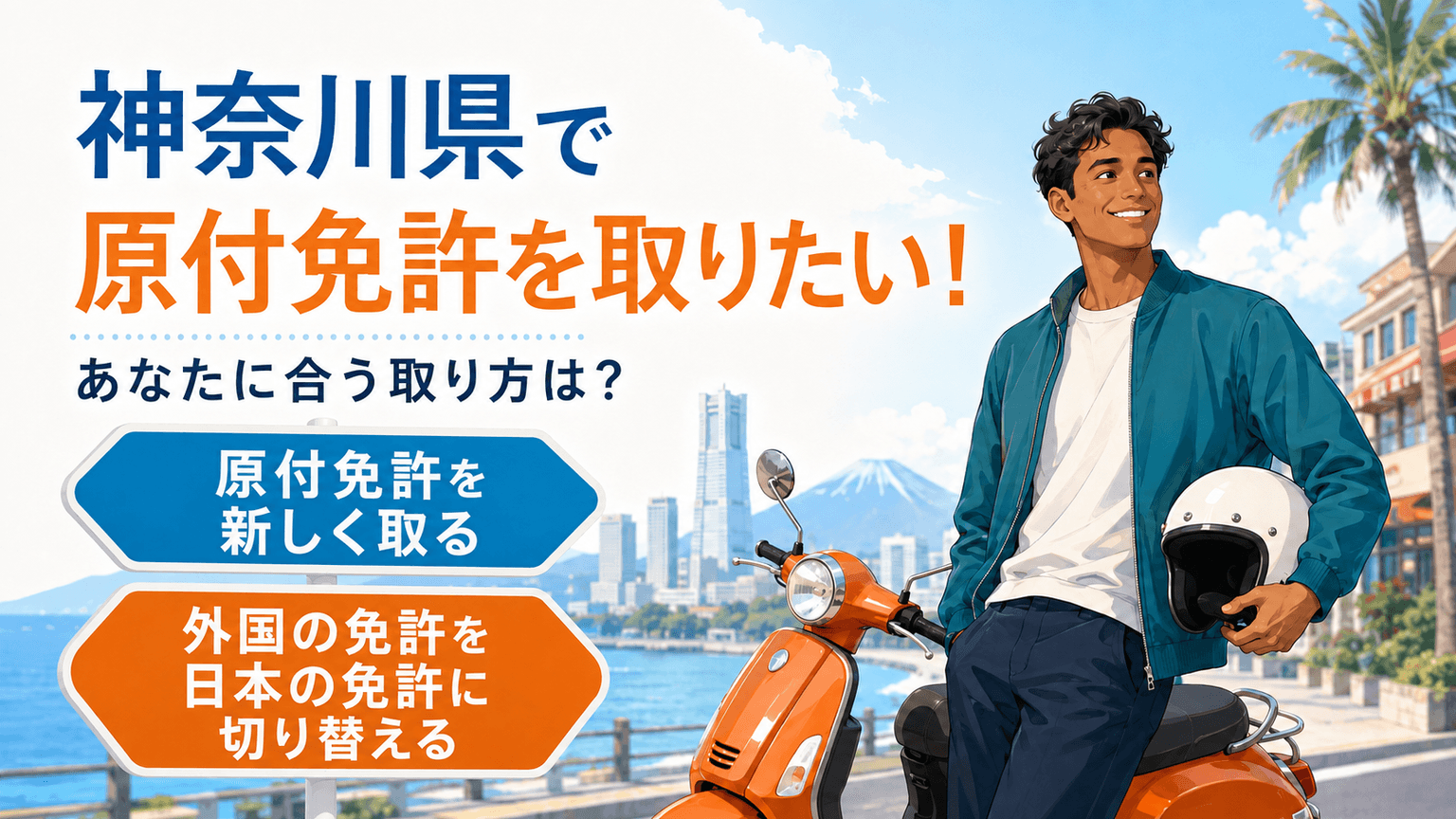
In Kanagawa and Chiba, the moped written test is available in English only. Within the same metropolitan area, crossing a prefectural border changes which languages you can sit the test in.
Take, for example, a Burmese speaker being placed at a workplace in Kanagawa. They cannot take the moped written test in their own language. If they hold a license from home, converting it to a moped license — available in 20 languages — becomes a real option. With no skills confirmation and no safety course, the only Japanese-language hurdle left is the 50-question knowledge confirmation.
Prefectures are also expanding their language support, and some have moved the moped test to 20 languages. Do not rely on last year's information — check the police website for the prefecture where the test will be taken.
What the conversion procedure involves
Conversion has a step that getting a new license at a licensing center does not. Before the knowledge confirmation, there is a document review.
The document review also requires a booking
Conversion is not simply a matter of booking a test. You first book the document review, and only after passing it do you proceed to the knowledge confirmation. That means booking twice.
In some prefectures you can take the knowledge confirmation on the same day the documents are approved; in others it falls on a separate day. A separate day adds to the total time. When working backwards from a start date, confirm which way your prefecture operates.
Missing paperwork means rejection
This is where things stall most often in practice. If a document is missing or wrong, the application does not go through, and you book again from the start. You never even reach the knowledge confirmation.
The main documents required:
The foreign driver's license (still valid)
A Japanese translation of the license — prepared by Zipplus, JAF (Japan Automobile Federation), or another authorized provider
A copy of the certificate of residence (juminhyo) — showing nationality, residence status, period of stay, and residence card number
The residence card and passport — older passports may be needed to verify the three months spent in the issuing country after the license was granted
One photo — 3 cm x 2.4 cm, taken within the last six months
👉 Have someone on the host side check the documents before sending the person in. The translation and the old passports that prove the length of stay are the two most commonly missed. A single rejection turns into weeks or months of delay.
Zipplus can prepare the Japanese translation of the license
Of all the required documents, the Japanese translation of the driver's license is the one most easily missed — and the one the host organization can most easily handle in advance. Left to the individual, they often arrive on the day without knowing where to get it, and the document review stops there.
That translation is prepared by Zipplus, the company behind Drivey.
One point of contact for both study and paperwork — no need to arrange learning materials and documents separately
Multiple people in one request — far more reliable than each person arranging it alone when you are taking on 10 or 20 at a time
Can be started before entry to Japan — begin it when study begins, and the document review can follow immediately after arrival
👉 Being turned away over the translation and having to rebook is the most wasteful way to lose time in the conversion process. Talk to us and handle it in one batch.
Check whether the person's country is exempt from testing
In license conversion, the knowledge and skills confirmations may be waived depending on the country that issued the license.
The 29 countries and regions exempt from both
Iceland / Ireland / United States (only Ohio, Oregon, Colorado, Virginia, Hawaii, Maryland, and Washington) / United Kingdom / Italy / Australia / Austria / Netherlands / Canada / South Korea / Greece / Switzerland / Sweden / Spain / Slovenia / Czech Republic / Denmark / Germany / New Zealand / Norway / Hungary / Finland / France / Belgium / Poland / Portugal / Monaco / Luxembourg / Taiwan
The countries most host organizations recruit from are all outside that list
Vietnam, Myanmar, Indonesia, China, Nepal, the Philippines, Thailand, Sri Lanka, Bangladesh — none of them appear on it. So anyone choosing conversion from these countries will have to sit the 50-question knowledge confirmation.
One condition applies whether or not the country is exempt: after obtaining the license, the person must have stayed in that country for a total of three months or more. Staff who came to Japan soon after getting their license may not meet this and may be unable to apply.
The knowledge confirmation changed substantially in October 2025
Until September 2025 |
From October 2025 |
|
Questions |
10 |
50 |
Passing score |
70% |
90% |
Question format |
Mostly illustration-based |
Mostly written statements |
Knowledge confirmation pass rate |
About 90% |
42.8% |
These are the figures the National Police Agency published for October to December 2025. Nine in ten became four in ten. Applications from people retaking the test have surged since the reform, so in some areas bookings are one to three months out.
The skills confirmation pass rate is 13.1%, but that figure applies to conversions of standard car and similar licenses. For moped conversions there is no skills confirmation at all. If you plan to have staff go on to a standard car license, however, build that 13.1% into your planning.
What the new-license route actually involves
The sequence is: aptitude test, written test, then the moped safety course.
The written test is 48 questions out of 50 points (46 written statements plus 2 illustration questions), and you need 45 points or more (90%) to pass
The pass rate is 58.7%
There is no driving test. After passing, applicants take the moped safety course (conducted in Japanese)
In many areas the test can be taken within a month of booking, and slots are generally easier to secure than for conversion
This is not a test you pass without studying
According to the National Police Agency's driver's license statistics for 2025, 162,668 people sat the moped written test and 95,495 passed. Put the other way round, 67,173 people failed it in a single year.
The passing line is a demanding 90%, and the questions are mostly written statements. Even taking it in one's own language, you cannot reach that mark without accurately understanding Japanese traffic rules.
A decision flow for host organizations
In the prefecture where they will be placed, can they sit the moped written test in their own language? If yes, the new-license route (58.7%) is strong
If not, do they hold a valid license from their home country? If yes, convert it to a moped license (20 languages, no skills confirmation, no safety course)
Did they stay in that country for three months or more after getting the license? If not, they cannot apply for conversion
Does that prefecture hold the document review and knowledge confirmation on the same day or separate days? If separate, allow for the extra time
How many months is the booking wait? Weigh that against the intended start date
If they have no home-country license and cannot test in their own language — the choice is between testing in English or studying until they can test in Japanese
👉 The question is not "which is easier" but "can this person take the test in a language they understand?"
[Important] Study can begin before arrival in Japan
In practice, this is what makes the biggest difference.
Both the written test and the knowledge confirmation ask about knowledge of Japanese traffic rules. That can be studied before coming to Japan. Handing over materials only after arrival means spending the run-up to employment on studying, and placement slips accordingly.
In practice, organizations are having people start studying two months before entry and sit the test soon after arriving. With an online learning environment, study can begin while the person is still in their home country, and the host organization can check their progress remotely from an administrator dashboard.
Before entry — study begins at home. All that is needed is an internet connection and a device. The translation can be prepared at the same time
Right after entry — they arrive prepared, with documents in order
For the host organization — you can see who has got how far, from before they arrive
👉 Simply not waiting until arrival to start moves the employment start date forward by one to two months.
About the Drivey corporate plan
Drivey handles written-test preparation and safe-driving education entirely online, and is a corporate platform that makes progress and results visible. It is operated by Zipplus, which also prepares the Japanese translations of foreign driver's licenses.
Covers both mopeds and license conversion
Moped, license conversion, provisional, standard car, and Class 2. Because study can start before the route is settled, learning continues even while you are still confirming what languages the destination prefecture supports.
Six languages
Japanese, English, Chinese, Vietnamese, Indonesian, and Burmese. Each user chooses their own language, so every member of staff gets the same opportunity to learn. Japanese with furigana is available too, so those testing in Japanese are not held back by kanji.
An administrator dashboard that makes progress visible
Member management |
Create accounts and send invitations; assign licenses by course |
Study management |
Check study time and progress, including progress rates by category |
Test management |
See test results and pass rates, and when and how often each person tested |
Reports |
Export per-person data reports as CSV or PDF |
What the learning looks like
Video — complex traffic rules and hazardous situations explained in ways text alone cannot convey
Conversational Q&A study — one question at a time, confirming that knowledge sticks
Comprehension checks and mock exams — from road sign tests to timed mock exams in the real format, so you can measure actual readiness
Beyond the license — hazard prediction, traffic ethics, and etiquette: the knowledge that keeps people alive
Pricing (tax included, per license, monthly)
Moped |
5,500 yen |
License conversion |
5,280 yen |
Provisional |
5,500 yen |
Standard car |
6,600 yen |
Class 2 |
8,800 yen |
Corporate plans include the administrator dashboard. A separate quotation is issued for the license conversion support package. Please ask about the translation service at the same time.
How to get started
Provisional registration — we email you a registration URL
Full registration — confirm your email address and set a password
Purchase licenses — buy as many as you need from the dashboard
Assign to staff — register them by name and email, and they receive an invitation
If you would prefer to pay by invoice, we will arrange that separately.
Summary
Neither moped route involves a driving test. Converting a foreign license to a moped license requires no skills confirmation and no safety course
The new-license route has a 58.7% written test pass rate and easier bookings. But it is available in only 1 to 5 languages depending on the prefecture, and the moped safety course is conducted in Japanese
Moped via conversion has a lower pass rate at 42.8%, but is available in 20 languages. It requires a home-country license and three months' stay after issuance
Conversion also requires booking the document review. Missing paperwork means rejection and rebooking. Zipplus can prepare the translation
The decision comes down to the prefecture. Tokyo offers the moped test in 5 languages on weekdays; Kanagawa and Chiba offer English only
67,173 people fail the moped written test each year. With a 90% passing line and written-statement questions, nobody passes it unprepared
Study can start before entry to Japan. Beginning two months ahead moves the employment start date forward by one to two months
From 2026 onward, getting foreign staff licensed is no longer something to leave to the individual — it is something the host organization designs.
Sources: National Police Agency, "Driver's License Statistics 2025" (moped written test: 162,668 examinees, 95,495 passes, 58.7% pass rate) / National Police Agency figures for October-December 2025 on foreign license conversion (knowledge confirmation 42.8%, skills confirmation 13.1%) / Tokyo Metropolitan Police Department, "Written tests available in foreign languages" (updated 11 May 2026) / Fukuoka Prefectural Police, "Converting a foreign driver's license" (no skills confirmation required for moped applications)
![Moped Licenses for Technical Intern Trainees and Specified Skilled Workers | Securing a Commute for Supervising Organizations and Registered Support Organizations, and the Route Available in Their Native Language [2026 Edition]](/_vercel/image?url=https:%2F%2Feswsspetwnfjmwiiduvc.supabase.co%2Fstorage%2Fv1%2Fobject%2Fpublic%2Fblog-images%2Fblogs%2F1789305380445.png&w=1536&q=100)
![How to Support Foreign Residents in Getting a Moped License: Methods, Reservations, and Preparation in Kanagawa Prefecture [For Employers and Supporters]](/_vercel/image?url=https:%2F%2Feswsspetwnfjmwiiduvc.supabase.co%2Fstorage%2Fv1%2Fobject%2Fpublic%2Fblog-images%2Fblogs%2F1789078192518.png&w=1536&q=100)