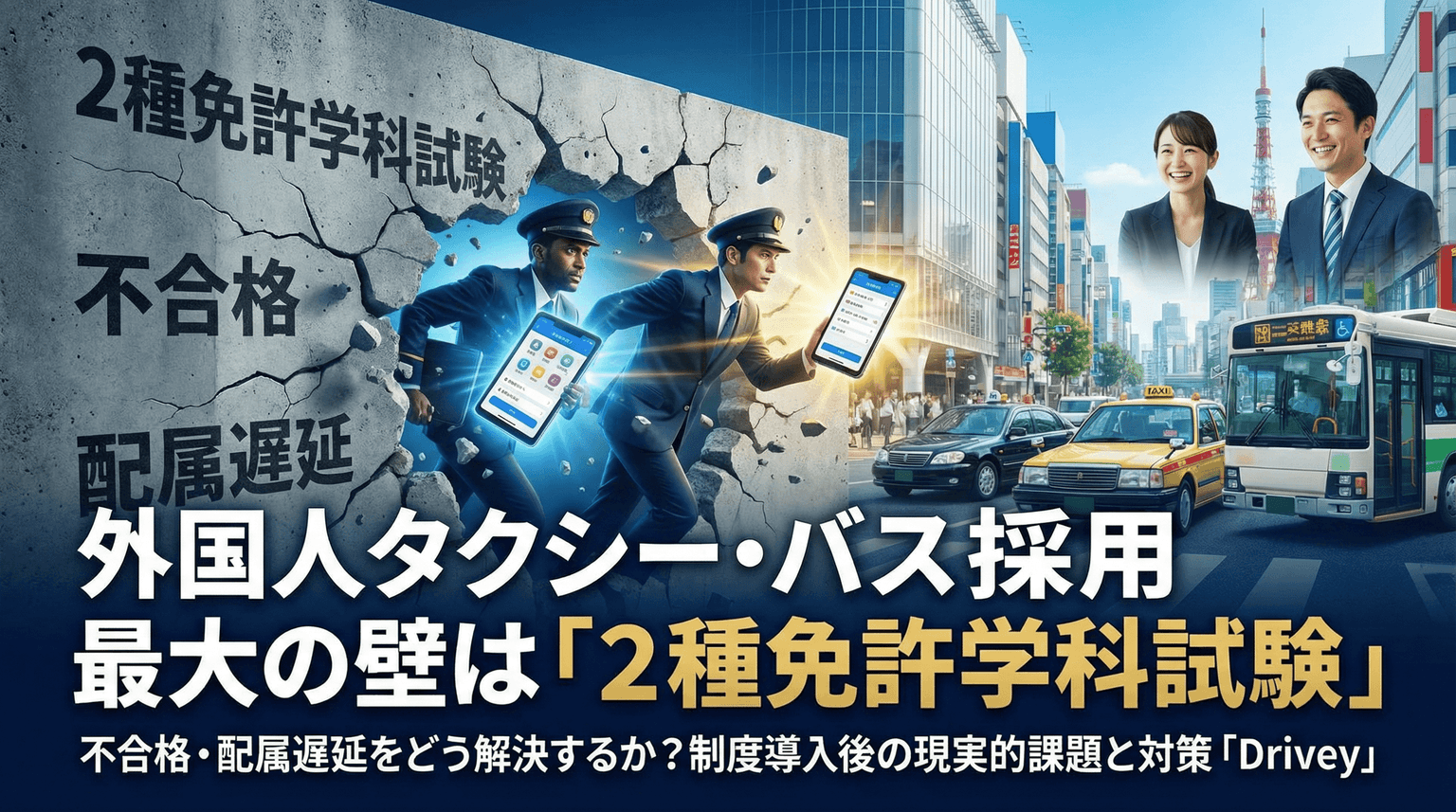
— How Recruiters Can Address Failures and Deployment Delays —
The Real Challenges That Have Emerged Since the System’s Introduction
Following the Cabinet decision in March 2024, the use of foreign human resources in the motor transport industry was formally institutionalized. Since then, the taxi and bus sectors have moved from policy discussion into the practical phase of hiring and training.
Hiring foreign drivers to address labor shortages is no longer a limited pilot initiative—it has become a realistic, industry-wide option.
However, now that the system is operational, new on-the-ground challenges have become clear.
Among them, one issue stands out across both taxi and bus operators:
Preparation for the Class 2 Driver’s License written exam, which is mandatory for foreign drivers.
Although written exams in foreign languages are now available nationwide—seemingly lowering institutional barriers—actual hiring sites are experiencing growing problems, including exam failures, retesting delays, postponed deployments, and increased training burdens.
To make foreign driver recruitment truly successful, companies must now confront the largest remaining obstacle:
the Class 2 written exam.
Why the Class 2 Written Exam Is Especially Difficult for Foreign Drivers
According to driver’s license statistics published by the National Police Agency, even Japanese applicants do not achieve high pass rates on the Class 2 written exam.
This is because the test goes beyond memorizing traffic rules. It evaluates the judgment, responsibility, and situational awareness required of professional drivers transporting passengers.
For foreign drivers, additional structural challenges apply:
Classroom lectures at driving schools are conducted almost exclusively in Japanese
Official textbooks are available only in Japanese
Legal wording and question phrasing are abstract and require advanced reading comprehension
In other words, even if the exam itself is offered in a foreign language, the learning process leading up to it remains heavily Japanese-centric. As a result, many candidates reach the exam without sufficient understanding.
Furthermore, training hours have been shortened due to system reforms, leaving less time than ever to thoroughly absorb academic content. This makes it increasingly common for drivers to complete training without fully understanding what they learned.
How the Challenges Differ Between Taxi and Bus Operators
Taxi Companies
Taxi operators often aim to put drivers on duty as quickly as possible. As a result, written exam failures directly lead to:
Retesting and delays
Disruptions to overall hiring plans
Lost revenue opportunities
The assumption that “once they pass the license, they can work” breaks down easily in practice.
Bus Companies
In contrast, bus operators face stricter demands for public responsibility and safety. Simply passing the exam is not enough.
Drivers must understand:
Why certain judgments are required
Why specific actions are dangerous
Without this level of comprehension, operational risks increase after deployment. For bus companies, passing with genuine understanding is essential.
Despite these differences, both sectors share the same conclusion:
Leaving written exam preparation entirely to driving schools has clear limitations.
The Turning Point for Hiring Success: Designing Pre-Training Academic Preparation
Companies actively hiring foreign drivers are beginning to recognize a key truth:
The success of foreign recruitment is determined not at graduation from driving school,
but before the final written exam is ever taken.
In other words, success depends on:
How much candidates understand before entering formal training
Whether the written exam becomes a confirmation step, rather than a hurdle
This is now the decisive factor in recruitment outcomes.
Drivey: A Practical Response to Post-Reform Challenges
In response to these realities, Ziplus Inc. launched Drivey in 2025—a written exam preparation service designed specifically for foreign drivers.
Drivey supports all major academic exams faced by foreign drivers, including:
Foreign license conversion
Learner’s permit
Full license
Moped license
Class 2 license (taxi and bus)
Why Drivey Is Valued
Drivey is not simply a question bank.
Its key features include:
Video-based explanations that clarify legal rules and decision-making logic
Simple Japanese and multilingual design, reducing dependence on Japanese proficiency
Step-by-step assessment tests that measure true understanding rather than rote memorization
This allows foreign drivers to approach exams with comprehension, not guesswork.
Benefits for Recruitment Managers
For taxi and bus recruitment teams, the benefits of adopting Drivey are clear:
Multilingual delivery of academic content and materials
Reduced risk of deployment delays due to exam failure
Less dependence on individual instructors or schools
Consistent professional driver quality
Standardization of the foreign recruitment process
Elimination of the risk of hiring candidates who cannot obtain licenses
Foreign recruitment shifts from an individual gamble to a repeatable, reliable system.
Conclusion: Foreign Driver Recruitment Now Begins with License Preparation
Foreign driver recruitment in the taxi and bus sectors is no longer theoretical—it is operational reality.
The key question is no longer how many drivers can be hired, but how reliably they can be deployed.
The decisive factor is:
Preparation for the Class 2 written exam.
Drivey directly addresses the challenges revealed after system implementation, supporting foreign drivers not merely to pass, but to understand, drive safely, and integrate successfully into real-world operations.
As such, it has become a practical and credible foundation for foreign driver recruitment in the taxi and bus industry.
![Moped Licenses for Technical Intern Trainees and Specified Skilled Workers | Securing a Commute for Supervising Organizations and Registered Support Organizations, and the Route Available in Their Native Language [2026 Edition]](/_vercel/image?url=https:%2F%2Feswsspetwnfjmwiiduvc.supabase.co%2Fstorage%2Fv1%2Fobject%2Fpublic%2Fblog-images%2Fblogs%2F1789305380445.png&w=1536&q=100)
![License Conversion Practice Questions | 21 Practice Questions with Answers for the 50-Question Knowledge Test [2026 Edition]](/_vercel/image?url=https:%2F%2Feswsspetwnfjmwiiduvc.supabase.co%2Fstorage%2Fv1%2Fobject%2Fpublic%2Fblog-images%2Fblogs%2F1789304570902.jpg&w=1536&q=100)
![How to Support Foreign Residents in Getting a Moped License: Methods, Reservations, and Preparation in Kanagawa Prefecture [For Employers and Supporters]](/_vercel/image?url=https:%2F%2Feswsspetwnfjmwiiduvc.supabase.co%2Fstorage%2Fv1%2Fobject%2Fpublic%2Fblog-images%2Fblogs%2F1789078192518.png&w=1536&q=100)