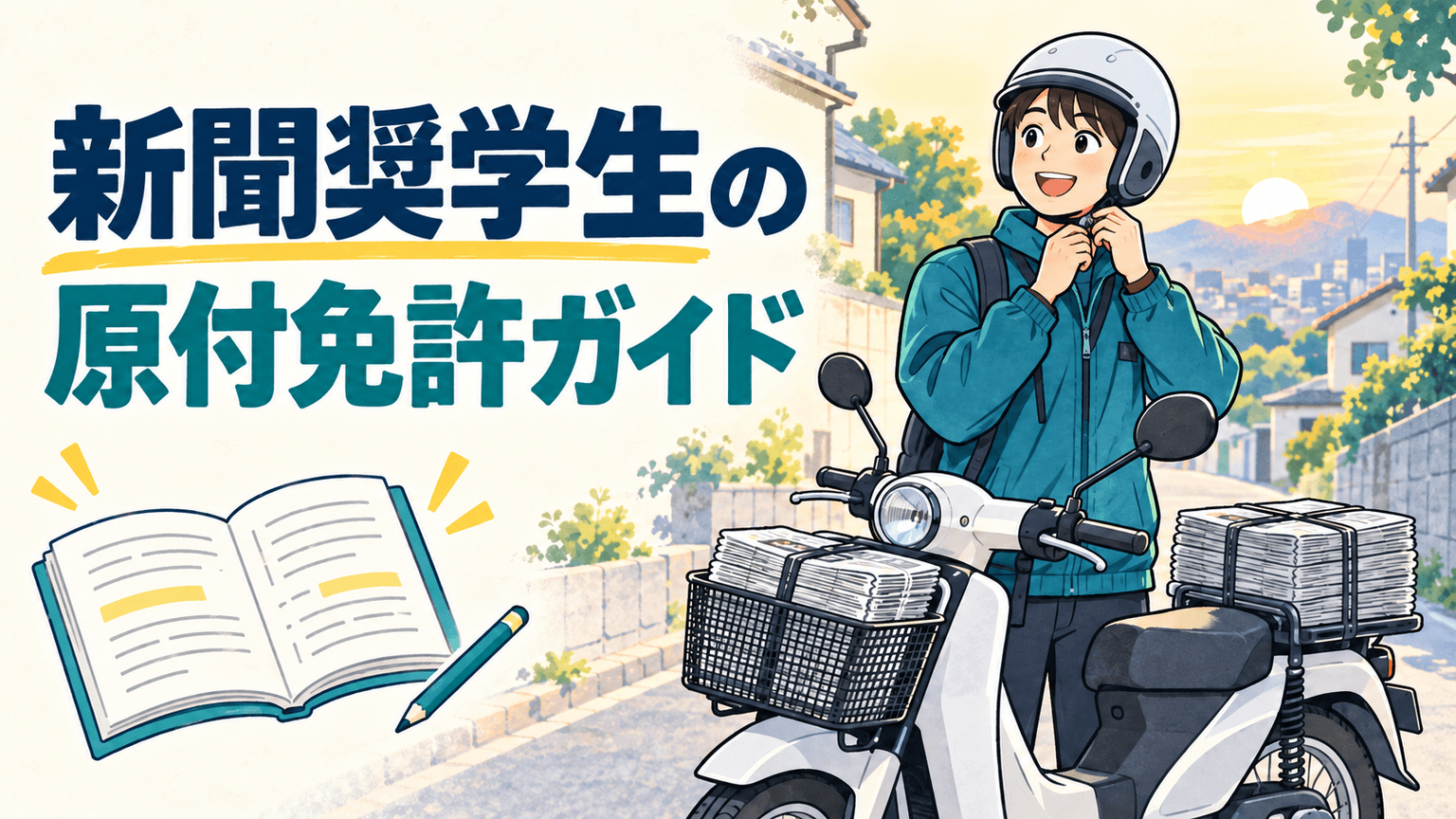
A guide to working backwards from the start date and choosing the route that fits the prefecture where the student will be placed
For newspaper delivery work, a moped license is effectively a requirement. On top of that, most scholarship associations recommend obtaining it before the student starts. In other words, the license is not something to deal with after arrival — it is a condition of entry itself.
When you accept international students as newspaper scholarship students, how you design the licensing process directly determines whether you can place them on schedule.
This article is written for staff at distributors, scholarship associations, and placement agencies, and covers how to choose the route and how to build a schedule backwards from the start date.
Please note: the contents of this article are current as of September 2026. Rules, supported languages, and fees change. Before starting any procedure, always confirm with the police or licensing center of the prefecture where the test will be taken.
【First, the basics】Neither route to a moped license includes a riding test
Let's start with the point that is most often misunderstood. There is no practical riding test for a moped license. That is true whether the license is newly obtained at a licensing center or acquired by converting a foreign license.
In a foreign license conversion, applicants normally take a skills confirmation (an actual driving test) in addition to the knowledge confirmation. However, when applying for a moped license, no skills confirmation is required. The moped training course is not required either.
👉 "Avoid the conversion route because the driving test is tough" does not apply to mopeds. The three things worth comparing are the pass rate, the languages the test is offered in, and the sequence of procedures.
The two routes to a moped license
New license at a licensing center |
Moped license via foreign license conversion |
|
Pass rate, written test / knowledge confirmation |
58.7% |
42.8% |
Riding test / skills confirmation |
None |
None |
Moped training course |
Required (Japanese only) |
Not required |
Languages the test is offered in |
1 to 5, depending on the prefecture |
20 languages |
Number of appointments needed |
One, for the test day |
Document review and knowledge confirmation (same day or separate days, depending on the prefecture) |
Waiting time |
Within a month in most areas |
One to three months in some areas |
Home-country license |
Not needed |
Required (plus 3 months or more of residence after obtaining it) |
👉 The deciding question is whether the student can take the written test in their native language in the prefecture where they will be placed. If they can, getting a new license is the stronger option because the pass rate is higher. If they cannot, the conversion route, available in twenty languages, is the more realistic one.
When the start date is fixed, waiting time becomes the binding constraint
For newspaper scholarship students, the start date is set in advance. That is exactly why "how many months will this take" matters more than "what is the pass rate."
Getting a new license at a licensing center is often chosen for the following reasons.
Appointments are easy to get — in most areas the test can be taken within a month
Only one appointment is needed — the conversion route takes two stages: document review and knowledge confirmation
It works even without a home-country license — many international students do not hold a license back home, and in that case the conversion route is not an option at all
Meanwhile, the number of repeat takers of the knowledge confirmation has risen since the rules changed, and some areas now have a one-to-three-month wait. If there is little room before the start date, this waiting time decides the matter.
【Most important】The languages available differ by prefecture
Support for twenty languages has been rolling out nationwide since June 2024, but that applies to the written tests for Class 1, Class 2, and provisional licenses, and to the knowledge confirmation for foreign license conversion. The written test for the moped license is set independently by each prefecture and is handled differently.
Tokyo (Metropolitan Police Department, updated 11 May 2026) |
5 languages (English, Chinese, Vietnamese, Nepali, Burmese) / offered on weekdays at Fuchu, Samezu, and Koto |
Kanagawa and Chiba |
English only |
Placement is determined by where the distributor is located. Even within the greater Tokyo area, a different prefecture means different test languages.
For example, if you place a Burmese speaker at a distributor in Kanagawa, they cannot take the moped written test in their native language. If that person holds a license back home, obtaining a moped license through the conversion route, which supports twenty languages, becomes a real option. Since there is no skills confirmation and no training course, the only Japanese-language hurdle is the 50-question knowledge confirmation.
👉 Check the prefecture's supported languages before you decide on placement. Some prefectures are starting to offer the moped test in twenty languages, so do not rely on last year's information.
If you choose the conversion route, the document review is where things stall
The conversion route involves a step that getting a new license at a licensing center does not. Before the knowledge confirmation, there is a document review.
The document review also requires an appointment
You first book an appointment for the document review, and only after clearing it can you move on to the knowledge confirmation. And some prefectures let the applicant take the knowledge confirmation on the same day the documents are approved, while others schedule it for a separate day. A separate day adds that much more time before the license is issued.
Missing paperwork leads to rejection
If any document is missing or incorrect, the application will not be accepted on the spot, and the appointment has to be booked all over again. The applicant cannot even reach the knowledge confirmation. The main required documents are as follows.
The foreign driver's license (still valid)
A Japanese translation of the license — prepared by Zipplus, JAF (Japan Automobile Federation), or another recognized organization
A copy of the certificate of residence — it must show nationality, residence status, residence expiry date, and residence card number
The residence card and passport — an old passport may be needed to verify that the applicant stayed in that country for three months or more after obtaining the license
One photograph — 3cm tall × 2.4cm wide, taken within the last six months
Zipplus can prepare the Japanese translation of the license
Of all the required documents, the one most likely to be overlooked — and the one the receiving organization can most easily handle in advance — is the Japanese translation of the driver's license. Leave it to the student and they may arrive on the day without knowing where to request it, and get stopped at the document review.
This translation is also prepared by Zipplus Inc., the company that operates Drivey.
Study materials and paperwork go through a single point of contact — there is no need to handle them separately
You can request several people at once — when you take in 10 or 20 students, this is more reliable than having each one arrange it individually
You can start before they enter Japan — if you set it in motion at the same time as their studies, they can go straight to the document review after arrival
👉 Having to rebook an appointment because of the translation is the most wasteful delay in the whole conversion process. For newspaper scholarship students with a fixed start date, that single delay hits the placement itself.
If the student has a home-country license, check whether they qualify for an exemption
In a foreign license conversion, both the knowledge confirmation and the skills confirmation may be waived depending on the country that issued the license. The following 29 countries and regions qualify.
Iceland / Ireland / United States (Ohio, Oregon, Colorado, Virginia, Hawaii, Maryland, and Washington only) / United Kingdom / Italy / Australia / Austria / Netherlands / Canada / South Korea / Greece / Switzerland / Sweden / Spain / Slovenia / Czech Republic / Denmark / Germany / New Zealand / Norway / Hungary / Finland / France / Belgium / Poland / Portugal / Monaco / Luxembourg / Taiwan
The countries that newspaper scholarship students mainly come from — Vietnam, Myanmar, China, Nepal, Indonesia, the Philippines, Sri Lanka, and Bangladesh — are none of them on that list. That means the 50-question knowledge confirmation is unavoidable.
A schedule worked backwards from the start date
Because the license is a condition of entry, work backwards from the start date. The following is a guideline for getting a new license at a licensing center.
2 months before entry |
Begin studying in the home country. Japanese traffic rules can be learned before arrival |
Before entry |
Check the supported languages in the placement prefecture and decide the route. For the conversion route, prepare the translation in parallel |
Right after entry |
Register the address of residence. Book the test (within a month in most areas) |
Test day |
Aptitude test → written test → moped training course. In some areas the training can be completed the same day if the applicant passes |
Start date |
Placement with the license already in hand |
If you choose the conversion route, add the document review appointment and a one-to-three-month wait to this. Work backwards from the start date and confirm first that it fits.
A failed test breaks the whole calculation. The application fee has to be paid again, and the appointment has to be rebooked.
The moped written test is not one you pass without studying
48 questions, 50 points total (46 text questions plus 2 illustration questions), 45 points or more (90%) to pass
The pass rate is 58.7%
According to National Police Agency statistics, 162,668 people took it in one year and 95,495 passed. Put the other way, 67,173 people failed
The passing line is a high 90%, and text questions dominate. Even when the test can be taken in the student's native language, they will not reach that line without an accurate understanding of Japanese traffic rules.
Lost points cluster around differences from how things work back home
Japan drives on the left — it is easy to misread sign directions and how to make turns
Pedestrian priority at crosswalks — the standard is to always stop if a pedestrian is about to cross
At railroad crossings you must always stop and open the window to check that it is safe — this is handled very differently from country to country
The definition of "proceeding slowly" — it means moving at a speed that allows an immediate stop, which is not the same as simply driving slowly
Starting from rote memorization of Japanese falls apart as soon as the wording shifts slightly. Understanding in one's native language why a rule exists is what makes it possible to handle a question seen for the first time.
Practical points when processing several people at once
Costs (Tokyo, as of September 2026)
Application fee (moped) |
1,600 yen |
License issuance fee |
2,350 yen |
Moped training course |
Charged separately (the amount varies by prefecture) |
If the applicant fails, the application fee is charged again. When processing 10 or 20 people, applying the 58.7% pass rate directly means roughly four in ten will be retaking the test. The quality of the preparation feeds straight back into cost and schedule.
Keep progress visible
When several people study at the same time, it becomes impossible to see who has covered what. Rely on self-reporting and you find out about the gaps right before the test. That is even more true when they study before entering Japan, so you need a way for the receiving organization to check the progress of people who are far away.
About the Drivey corporate plan
Drivey is a corporate platform that handles written-test preparation and safe-driving education entirely online and makes the progress and results visible. It is operated by Zipplus Inc., which also prepares Japanese translations of foreign driver's licenses.
Study can begin two months before entry
With an internet connection and a device, students can start studying while still in their home country. On the corporate dashboard, the receiving organization can check remotely how far each person has progressed. Compared with handing over materials only after arrival, the margin before the start date is entirely different.
Both the moped and the conversion routes are covered
Moped, foreign license conversion, provisional, standard, and Class 2 licenses are all covered, so preparation can begin before the route is settled. Even if you follow the approach of deciding the route after checking the prefecture's supported languages, the studying never has to stop.
Six languages
Japanese, English, Chinese, Vietnamese, Indonesian, and Burmese. Students can understand what Japanese traffic rules mean in their native language before sitting the real test. Japanese with furigana is also available, so those taking the test in Japanese can study without getting stuck on kanji.
The corporate dashboard
Member management |
Create and invite accounts, and assign licenses by course (license type) |
Study management |
Check study time, progress, and completion rates by category |
Test management |
Track test results and pass rates, along with dates and number of attempts |
Reports |
Export data reports as CSV or PDF |
What the studying involves
Video — situations that text alone cannot convey, such as stopping at a crosswalk or crossing a railroad crossing, can be seen on screen
Interactive Q&A study — one question at a time to confirm that the knowledge has stuck
Comprehension checks and mock exams — from sign quizzes to timed mock exams, students can measure themselves in the same format as the real test
What comes after the license too — hazard prediction, traffic ethics, and etiquette: knowledge that is a matter of life and death in delivery work
Pricing (tax included, monthly per license)
Moped |
5,500 yen |
Foreign license conversion |
5,280 yen |
Provisional license |
5,500 yen |
Standard license |
6,600 yen |
Class 2 license |
8,800 yen |
Corporate plans include the corporate dashboard. If you use the "Foreign License Conversion Support Package," we will provide a separate quotation. Please also feel free to ask about translation services. Invoice-based payment can be arranged on request.
Summary
A moped license is effectively required for newspaper delivery, and obtaining it before the start date is recommended. The license is a condition of entry
Neither route to a moped license includes a riding test. When obtaining a moped license through the conversion route, neither the skills confirmation nor the moped training course is required
Getting a new license at a licensing center means a 58.7% written-test pass rate and a single, easy-to-book appointment. However, the test is available in only 1 to 5 languages, and the moped training course, conducted in Japanese, is mandatory
A moped license via conversion has a lower pass rate — 42.8% on the knowledge confirmation — but can be taken in 20 languages. That said, the document review also requires an appointment, and missing paperwork leads to rejection. Zipplus can prepare the translation
The decision comes down to the prefecture of placement. Tokyo offers the moped test in 5 languages on weekdays; Kanagawa and Chiba offer English only
On the moped written test, 67,173 people fail every year. Nobody gets through without studying first
Study can start two months before entry. Make sure the receiving organization can check progress remotely
Rules, supported languages, and fees change. This article reflects information as of September 2026. Before starting any procedure, confirm the latest information with the police or licensing center of the prefecture where the test will be taken.
Sources: National Police Agency, "Driver's License Statistics, 2025 Edition" (moped written test: 162,668 examinees, 95,495 passes, 58.7% pass rate) / National Police Agency figures for foreign license conversions from October to December 2025 (knowledge confirmation 42.8%, skills confirmation 13.1%; reported by Nikkei and NTV NEWS NNN) / Tokyo Metropolitan Police Department, "Written Tests Available in Foreign Languages" (updated 11 May 2026) / Fukuoka Prefectural Police, "Procedures for Converting a Foreign License" (no practical confirmation is required when applying for a moped license)
![Moped Licenses for Technical Intern Trainees and Specified Skilled Workers | Securing a Commute for Supervising Organizations and Registered Support Organizations, and the Route Available in Their Native Language [2026 Edition]](/_vercel/image?url=https:%2F%2Feswsspetwnfjmwiiduvc.supabase.co%2Fstorage%2Fv1%2Fobject%2Fpublic%2Fblog-images%2Fblogs%2F1789305380445.png&w=1536&q=100)
![How to Support Foreign Residents in Getting a Moped License: Methods, Reservations, and Preparation in Kanagawa Prefecture [For Employers and Supporters]](/_vercel/image?url=https:%2F%2Feswsspetwnfjmwiiduvc.supabase.co%2Fstorage%2Fv1%2Fobject%2Fpublic%2Fblog-images%2Fblogs%2F1789078192518.png&w=1536&q=100)