Please know just one thing first.
For both the provisional license (karimen) and the full license (honmen), the pass line is 90%.
Provisional license You pass with 45 of 50 correct. You can miss only 5 questions
Full license You pass with 90 out of 100 points. You can lose only 10 points
90% Pass line for both | 5 questions You can miss on the provisional | 10 points You can lose on the full |
In other words, "I got 70% right" means you fail.
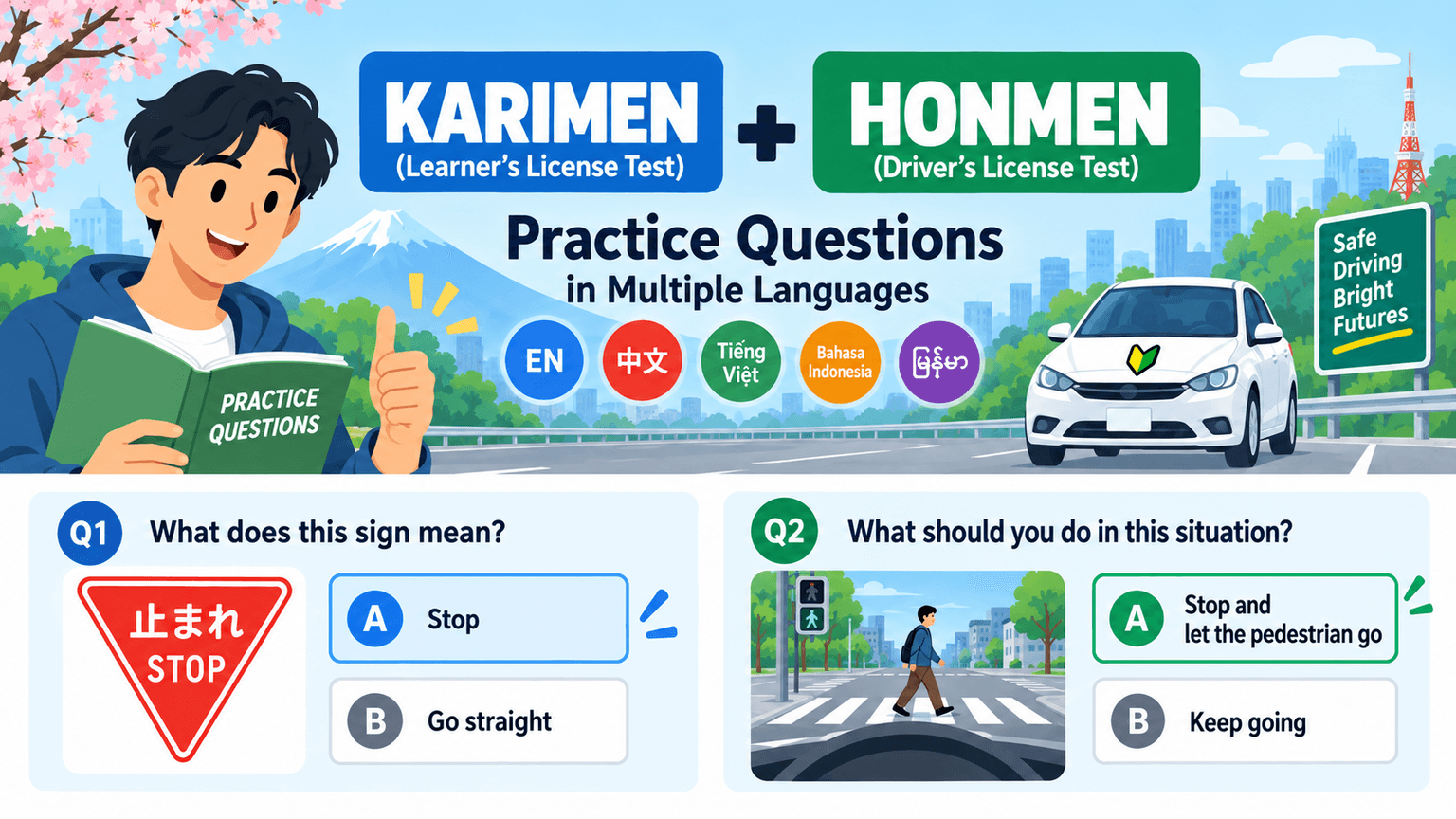
This article gives you 35 questions in total: 15 provisional and 20 full license questions. The answers are in the second half of the article, so solve them all first, then look at the answers.
👉 Only 32 correct out of 35 reaches the real pass line (90%). 25 correct is 71.4%. That would fail the real exam.
*This information is as of September 2026. Before you take the exam, check with the police or driver's license center in the prefecture where you live.
The reason people fail is not their Japanese
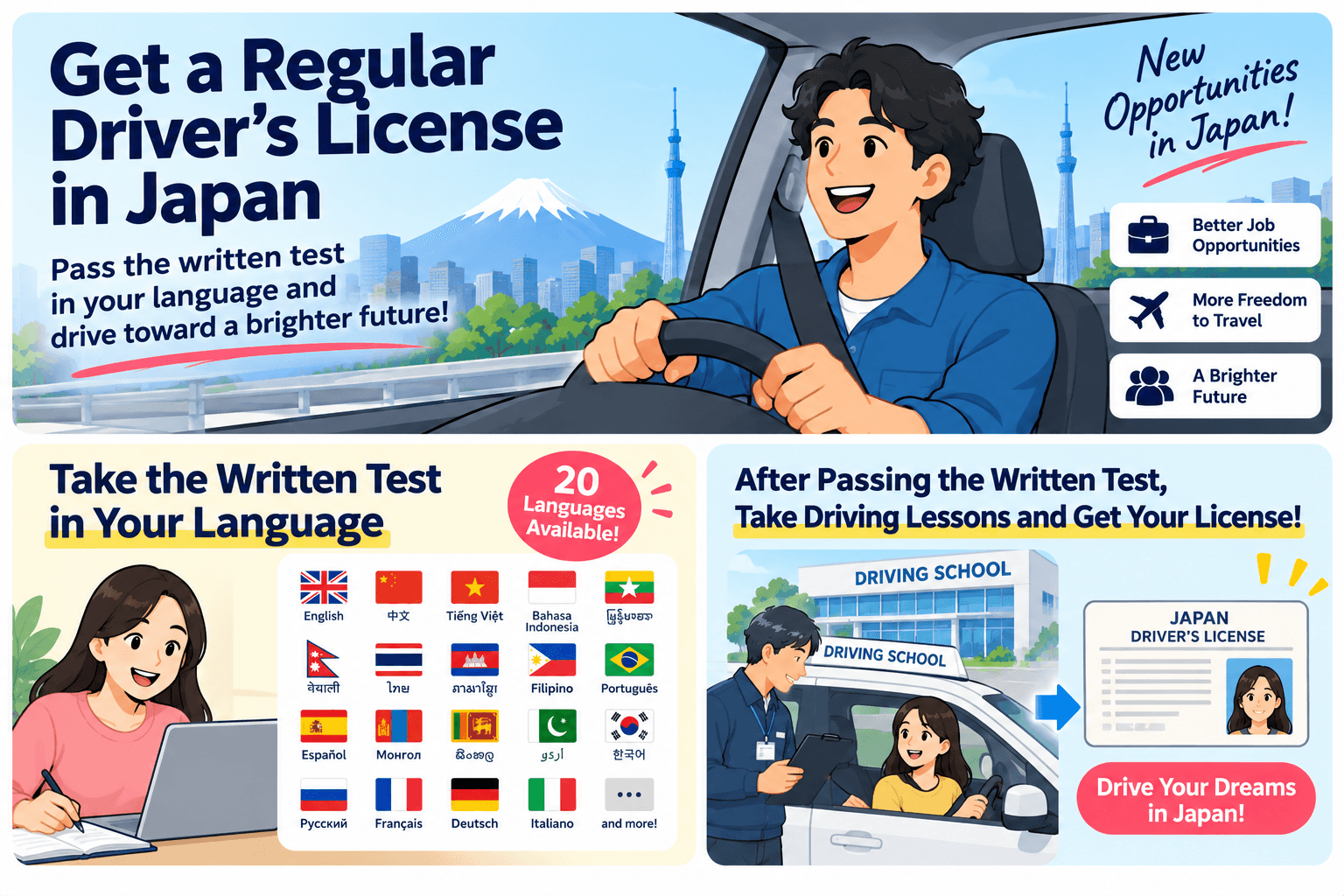
The written exams are available in 20 languages (when taken at a driver's license center). Even though they can take it in their native language, some people still fail.
The reason is in how the questions are made.
We checked all 962 questions in Drivey's provisional license course and found the following.
Questions containing "always" | 20 questions among them had the answer × |
|---|---|
Questions containing "in principle" or "clearly" | 24 of 36 had the answer ○ |
This is not a coincidence. The way words are used is itself the trick in the questions.
The causes of failing fall into 4 patterns
Pattern | Words to watch for | When you find them |
|---|---|---|
Pattern 1 Absolute words | always / all / at all times / never | Suspect × (look for exceptions) |
Pattern 2 Condition words | in principle / clearly / except | Suspect ○ (they allow exceptions) |
Pattern 3 Swapped numbers | 3 seconds / 30 meters / 5 meters | Check "what" the number belongs to |
Pattern 4 Scope of words | vehicle / vehicles / light vehicles / motor vehicles | Think about what the word includes |
👉 However, some questions cannot be solved by pattern alone. Of these 35 questions, 7 cannot be answered even if you know the patterns. They test knowledge itself. We explain these later.
Part 1 Provisional license range (Questions 1–15)
Do not write the answers yet. First, solve all 15 questions in a row.
Question 1. At an intersection with a flashing yellow signal, you are always required to go slow.
Question 2. When passing a child walking alone, you must not only go slow but always stop.
Question 3. As a safe distance from pedestrians, you must always keep a distance of 1.5 meters or more.
Question 4. If you cause a traffic accident, your driver's license is always provisionally suspended.
Question 5. In a tunnel without traffic lanes, in principle you cannot overtake, even when there is no oncoming traffic.
Question 6. A safety zone is, in principle, a place where vehicles must not drive.
Question 7. When a young child rides in a car, in principle a child seat must be used, whether in the front seat or the back seat.
Question 8. The signal for a right or left turn must be given at a point 30 meters before the intersection.
Question 9. With a medium-sized vehicle license, you can drive a microbus with a seating capacity of 30 or more.
Question 10. On a standard motorcycle, wearing a helmet is required even when a sign or similar limits the maximum speed to 30 km/h.
Question 11. When towing a broken-down vehicle with a gross weight over 750 kilograms by rope with a regular car, a towing license is not required.
Question 12. All vehicles can go straight, turn left and turn right at a green signal.
Question 13. When a "streetcar tracks may be used" sign is posted, not only motor vehicles but also mopeds and light vehicles can drive on the tracks.
Question 14. When the motor vehicle in front is about to overtake a moped, overtaking that motor vehicle is prohibited as double overtaking.
Question 15. The penalty point system for traffic violations applies not only to drivers of motor vehicles but also to moped riders.
Part 2 Full license only range (Questions 16–35)
From here, the range does not appear in the provisional license exam. Expressways, parking and stopping, loading and what to do in accidents are added.
Expressways (Questions 16–20)
Question 16. On an expressway, on dry paved road with tires in good condition, keep a following distance of about 100 meters or more at 100 km/h.
Question 17. The maximum speed of a towing vehicle on an expressway is 80 km/h.
Question 18. To ride a two-wheeled vehicle with a passenger on an expressway, the rider must be 20 or older and have held a large or standard motorcycle license for a total of 3 years or more.
Question 19. Vehicles that cannot reach 50 km/h or more due to their structure cannot use either expressways or motor-vehicle-only roads.
Question 20. If you take the wrong exit on an expressway, backing up using the shoulder is allowed because it does not block other traffic.
Parking and stopping (Questions 21–24)
Question 21. Stopping to let people on or off, or to load or unload goods within 5 minutes, is parking, not stopping.
Question 22. On roads where the roadside strip is 0.75 meters wide or less, park at the left edge of the roadway without entering the roadside strip.
Question 23. When the roadside strip is wide, you may enter it to park or stop, but you must leave 0.75 meters or more of space on the left side of the vehicle.
Question 24. Even on roads where parking is not prohibited by signs or similar, you cannot park unless there is 3.5 meters or more of space on the road to the right of the vehicle.
Passengers and loading (Questions 25–27)
Question 25. For a car's seating capacity, 2 children under 12 are counted as 1 adult.
Question 26. If you get permission to load goods beyond the loading limits, you must attach a white cloth of 0.3 square meters or more in an easy-to-see place on the load during the daytime.
Question 27. For three-wheeled motor vehicles and regular cars with an engine displacement of 660 cc or less, the height of the load is limited to 2.5 meters from the ground.
Forces acting on a vehicle (Questions 28–30)
Question 28. Braking distance and centrifugal force are proportional to the square of the speed, so if the speed doubles, the braking distance and the force trying to make the car skid sideways on a curve become 4 times greater.
Question 29. If you crash into a concrete wall at 60 km/h, you receive about the same impact as falling from a height of about 14 meters (about the 5th floor of a building).
Question 30. When cars cannot pass each other on a narrow slope, the car going downhill gives way, because starting on an uphill slope is difficult.
Accidents and inspection (Questions 31–35)
Question 31. When you cause a traffic accident, first report to a police officer, then help the injured.
Question 32. When a traffic accident happens, helping the injured and reporting to a police officer are done by the driver with the greater responsibility for the accident.
Question 33. When you happen to be at the scene of a traffic accident, actively help with aiding the injured and moving the vehicles involved.
Question 34. Daily inspection of a private passenger car must always be done once every day.
Question 35. When a motor vehicle overtakes a bicycle, it must always leave a side distance of 1 meter or more.
Answers and explanations
Questions 1–4 (Pattern 1 Absolute words)
Question 1 (flashing yellow signal) Answer × Flashing yellow means "you may proceed with caution". It does not go as far as requiring you to go slow.
Question 2 (child walking alone) Answer × It is fine if you can pass safely by either stopping or going slow. It is not "always stop".
Question 3 (distance from pedestrians) Answer × It is 1 meter or more when passing each other face to face, and 1.5 meters or more when passing from behind. There is not just one number.
Question 4 (provisional suspension of license) Answer × It may happen when you cause a serious, malicious accident. It does not always happen whenever you cause an accident.
👉 All 4 questions contained "always", and all 4 were ×. When you find this word, first look for exceptions.
Questions 5–7 (Pattern 2 Condition words)
Question 5 (overtaking in a tunnel) Answer ○ In a tunnel without traffic lanes, overtaking is prohibited even when there is no oncoming traffic.
Question 6 (safety zone) Answer ○ A safety zone protects people such as those waiting for streetcars. Vehicles cannot enter it.
Question 7 (child seat) Answer ○ Children under 6 need a child seat in both the front and back seats.
👉 All 3 questions contained "in principle", and all 3 were ○. This phrase means "there are exceptions, but this is the basic rule". It does not deny the sentence.
Questions 8–11 (Pattern 3 Numbers)
Question 8 (timing of signals) Answer ○ The signal for right turns, left turns and U-turns is given 30 meters before. The signal for changing course is "3 seconds before", which is different.
Question 9 (medium-sized vehicle license) Answer × With a medium-sized vehicle license, you can drive vehicles with a seating capacity of 29 or less. For 30 or more, you need a large vehicle license. A difference of just one number changes the answer.
Question 10 (helmet) Answer ○ Speed limits and helmets are not related. Wearing one is required even on 30 km/h roads. The question shows a number but asks about something else.
Question 11 (towing license) Answer ○ When towing a broken-down vehicle by rope, a towing license is not needed. The number 750 kilograms is not related to this exception.
Questions 12–15 (Pattern 4 Scope of words)
Question 12 (green signal) Answer × "All vehicles" includes light vehicles and specified small motorized bicycles. These 2 cannot turn right directly (they use a two-step right turn). This question combines Pattern 1 and Pattern 4.
Question 13 (streetcar tracks may be used) Answer × With this sign, only motor vehicles can enter. Mopeds and light vehicles cannot.
Question 14 (double overtaking) Answer × It is double overtaking when the vehicle in front is overtaking a "motor vehicle". If the lead vehicle is a moped, it does not apply. "Motor vehicle" and "vehicle" are different words.
Question 15 (penalty point system) Answer ○ It applies to all drivers of vehicles that require a license. Mopeds are included.
👉 In Japanese traffic rules, "vehicle", "vehicles", "motor vehicle" and "light vehicle" each mean something different. You need to understand this in your native language.
Questions 16–20 (Expressways)
Question 16 (following distance) Answer ○ Remember to keep as many meters as the speed number. At 100 km/h, keep 100 meters or more.
Question 17 (maximum speed when towing) Answer ○ A vehicle that is towing can go up to 80 km/h, because it is longer and needs more distance to stop.
Question 18 (riding with a passenger) Answer ○ 20 or older, and holding a license for a total of 3 years or more. You must meet both conditions.
Question 19 (vehicles that cannot reach 50 km/h) Answer × They cannot use national expressways, but they can use motor-vehicle-only roads. These are 2 different kinds of roads.
Question 20 (backing up on the shoulder) Answer × Backing up is prohibited even on the shoulder. If you pass your exit, continue to the next interchange.
Questions 21–24 (Parking and stopping)
Question 21 (loading within 5 minutes) Answer × This is "stopping", not parking. The question swaps the definitions of the words.
Question 22 (roadside strip 0.75 meters or less) Answer ○ Do not enter a narrow roadside strip; stop at the left edge of the roadway.
Question 23 (wide roadside strip) Answer ○ You may enter, but leave 0.75 meters or more on the left side of the vehicle. Questions 22 and 23 use the same number, 0.75 meters, to say opposite things.
Question 24 (3.5 meters on the right) Answer ○ Even without a no-parking sign, you cannot park unless there is 3.5 meters or more of space to the right of the vehicle.
Questions 25–27 (Passengers and loading)
Question 25 (counting seating capacity) Answer × 3 children under 12 count as 2 adults. It is not "2 children as 1 adult".
Question 26 (cloth on an overhanging load) Answer × It is a red cloth, not white. The number (0.3 square meters) is correct; only the color is wrong.
Question 27 (height of the load) Answer ○ For three-wheeled motor vehicles and regular cars of 660 cc or less, it is up to 2.5 meters. For two-wheeled vehicles and mopeds it is up to 2 meters, a different number.
Questions 28–30 (Forces acting on a vehicle)
Question 28 (square of the speed) Answer ○ When the speed doubles, both the stopping distance and centrifugal force become 4 times greater. Slowing down just a little greatly reduces danger.
Question 29 (impact at 60 km/h) Answer ○ It is said to be the same as falling from the 5th floor of a building.
Question 30 (narrow slope) Answer ○ The car going downhill gives way, because starting again after stopping on an uphill slope is difficult.
Questions 31–35 (Accidents and inspection)
Question 31 (report first or help first) Answer × Helping the injured comes first. The question swaps the order.
Question 32 (driver with greater responsibility) Answer × Who reports is not decided by the degree of responsibility.
Question 33 (being at the scene) Answer ○ Even if you are not involved in the accident, actively help.
Question 34 (daily inspection) Answer × Daily inspection of a private car is done "at appropriate times, on your own responsibility"; it is not fixed as once every day. Once every day is required for commercial vehicles.
Question 35 (distance from bicycles) Answer × The law requires "sufficient distance", not the number 1 meter. If you cannot keep enough distance, slow down as you pass.
How many of the 35 did you get right?
The real pass line is 90%. As a percentage of 35 questions, 32 correct is 91.4%. 31 correct is 88.6%, which would fail the real exam.
32–35 correct | You can compete in the real exam. The next stage is to do more questions and become stable |
25–31 correct | This is the largest group. You have the knowledge but lose points to word patterns |
24 or fewer | You need to relearn the rules themselves. Study the units before solving questions |
👉 25 correct is 71.4%. Even if you feel "I got 70% right", you would fail the real exam. This gap in how you feel is the most dangerous thing.
Which pattern made you lose points?
Match the numbers of the questions you got wrong to the table below.
Pattern | Question numbers | What to do if you lost points here |
|---|---|---|
Pattern 1 Absolute words | 1, 2, 3, 4, 34, 35 | Underline "always" and "at all times" before reading |
Pattern 2 Condition words | 5, 6, 7 | Remember that "in principle" does not deny the sentence |
Pattern 3 Numbers | 8, 9, 10, 11, 16, 17, 18, 21, 22, 23, 24, 25, 26, 27 | Relearn not just the numbers, but what each number belongs to |
Pattern 4 Scope of words | 12, 13, 14, 15, 19 | Check the differences between "vehicle", "motor vehicle" and "light vehicle" in your native language |
No pattern | 20, 28, 29, 30, 31, 32, 33 | These cannot be solved by pattern. The only way is to study the unit |
👉 Look at the bottom row. 7 of the 35 questions cannot be answered even if you know the patterns. The ban on backing up, the relationship between speed and impact, giving way on slopes and the order of actions in an accident — for these, you either know them or you don't.
The full license has one more trap
The 95 questions of the full license exam include 5 illustration questions.
Each illustration has 3 questions, and you get 2 points only when all 3 are correct. If even one is wrong, you get 0 points. There is no partial credit.
The 5 questions are worth 10 points. The pass line is 90 points.
👉 If you lose all the illustration questions, you would need to get all 90 text questions right to reach 90 points. These are 10 points you cannot afford to lose.
What these 35 questions can and cannot tell you
We will be honest.
What they can tell you
Which "pattern" makes you lose points: absolute words, condition words, numbers or the scope of words. This article can tell you this much.
What they cannot tell you
35 questions cannot tell you which "units" are weak.
The provisional license written content has 14 units, and the full license adds 15 more. For 29 units in total, 35 questions is only a little over 1 question per unit. That is not enough to measure which units are weak.
And this article cannot give you the same conditions as the real exam. For the full license, you answer 95 questions in 50 minutes, which is 30 seconds per question. You cannot practice reading under time pressure in an article.
👉 Once you know your patterns, the next steps are "which units are weak" and "can you finish in time". An article cannot fill these 2 gaps.
What is free and what is paid on Drivey
You can sign up for Drivey for free and see some units for free. Here is what is free, so you know before you start.
Course | Units | Free | Price (tax included) |
|---|---|---|---|
14 units / 530 questions | 2 units | 2,200 yen per month | |
29 units / 950 questions | 2 units | 3,300 yen per month |
👉 The prices above are for 1 month of personal use. It is a monthly plan, so if you use it for 2 months, you pay for 2 months. For companies and organizations using it together, the price is different, because they can see employees' study progress on an admin screen (corporate services).
With the 2 free units, you can see what the videos, Q&A and mini tests are like.
However, these 2 things are not available for free.
The feature that finds weak points by unit — this shows "which units are weak", which this article could not tell you
Mock exams — solved with the same number of questions and the same time as the real exam
👉 In other words, the 2 things this article showed are missing are exactly the paid parts. It is not designed so that you can judge everything for free. We want to be honest about that.
👉 First, use the 2 free units to check that the explanations in your language are easy to read. The supported languages are 6: Japanese (also with furigana), English, Chinese, Vietnamese, Indonesian and Myanmar.
What to do next (3 steps)
Step | What to do | Time guide |
|---|---|---|
1 | Go through all the units once (understand the meaning in your native language) | Provisional 1.5 hours / full 2 hours |
2 | Solve practice questions and go back only to what you got wrong | 1.5 hours each |
3 | Take 2 to 4 mock exams, until you are steadily above 90% | 30 to 50 minutes each |
👉 Some people go above 90% in 2 tries, and some need 4. Judge not by the number of tries, but by whether you can stay above it steadily.
Frequently asked questions
Q. Are these 35 questions from the real exam?
No. Past written exam questions are not published. These 35 questions are included in Drivey's provisional license and regular license courses, and were made according to the exam range.
Q. Which languages can I take the exam in?
At a driver's license center, 20 languages. However, for the provisional license written exam taken inside a designated driving school, the school decides which languages you can take it in. For details, see How foreign residents get a regular driver's license in Japan.
Q. I have a license from my home country. Do I need to take this exam?
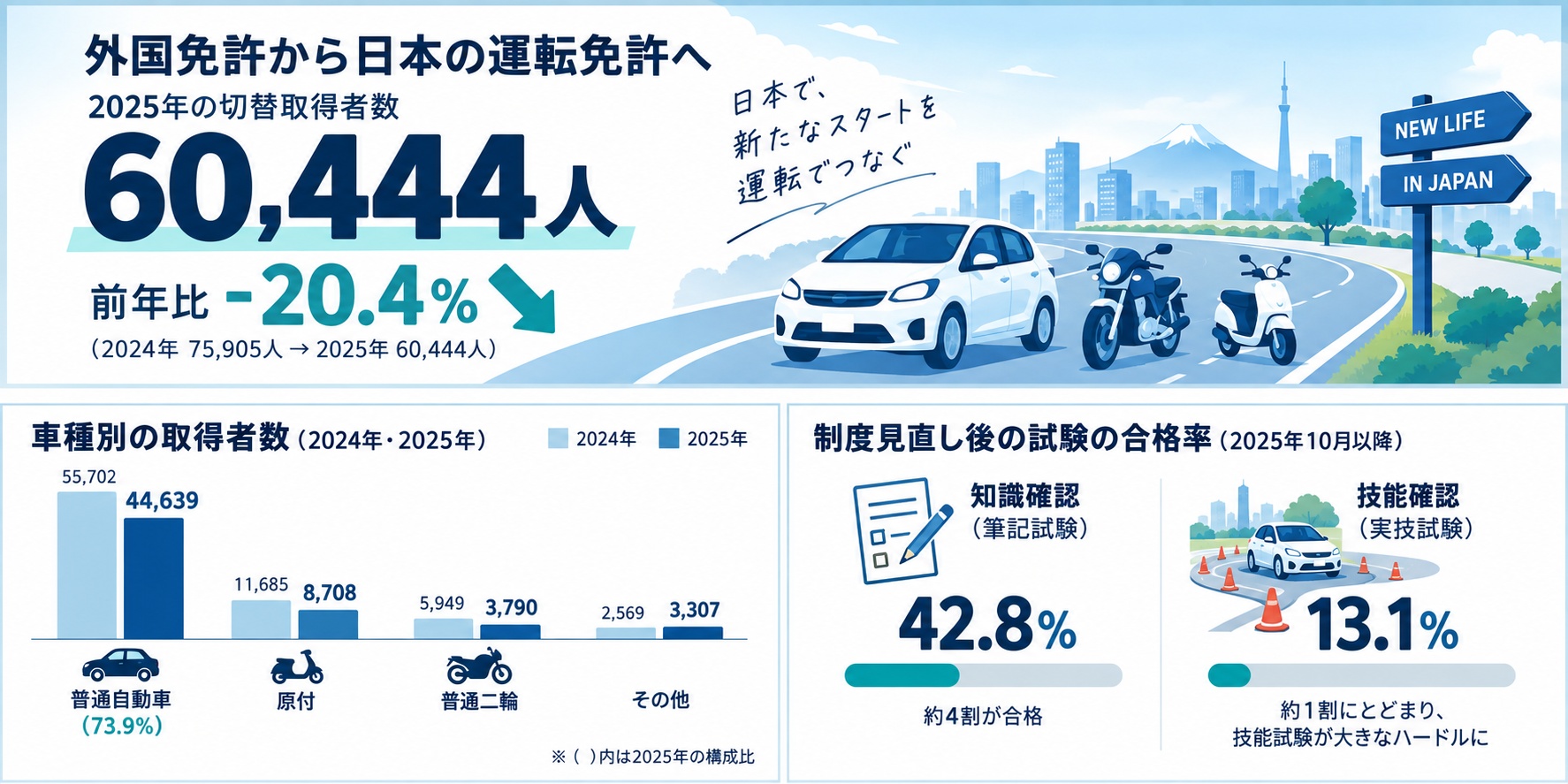
If you have a driver's license from your home country, there is a separate procedure called license conversion (gaimen kirikae). The exam is also different. See the license conversion knowledge test (50 questions) and 50 license conversion practice questions.
Q. Should I study for the provisional or the full license first?
The provisional license. The full license range includes the provisional license range. What you learn for the provisional license can be used directly for the full license.
Q. Can I use Drivey if I take the exam in Japanese?
Yes. There is Japanese with furigana, so you can study even if you cannot read kanji. You can first understand the content in your native language and then get used to the Japanese question text.
Summary
The pass line is 90%. You can miss only 5 of 50 on the provisional, and only 10 points on the full license
"I got 70% right" is a fail. With these 35 questions, 32 correct just reaches the pass line
The causes of failing are 4 patterns: absolute words, condition words, numbers and the scope of words
When you find "always", suspect ×. In Drivey's 962 provisional license questions, 20 questions containing "always" were ×
"In principle" does not deny the sentence. 24 of 36 questions with condition words were ○
However, 7 of the 35 questions cannot be solved by pattern. The only way is to study the units
The full license illustration questions are 5 questions worth 10 points. You get 2 points only when all 3 parts are correct, and 0 points if even one is wrong
This article can tell you your "patterns". It cannot tell you which units are weak or whether you can answer 95 questions in 50 minutes
Not being able to read Japanese is different from not understanding traffic rules. The written exams are available in 20 languages. People fail not because of the language, but because they do not know how the questions are made.
👉 You can try the provisional license course and regular license course starting with 2 free units.
👉 If you support several learners at a company, supervising organization, registered support organization or similar, please see our corporate services. On the admin screen, you can check remotely who has progressed how far. For quotes and demos, please use our contact form.
Start with 2 free units Sign up to try the videos, Q&A and mini tests for free. Available in 6 languages: Japanese (also with furigana), English, Chinese, Vietnamese, Indonesian and Myanmar. |
Sources: The number of questions, scoring and pass line are from Osaka Prefectural Police, "Regular License" (full license exam 95 questions, 50 minutes, 90% or more; provisional license exam 50 questions, 30 minutes, 90% or more) / Eligibility is from Tokyo Metropolitan Police Department, "Regular provisional license exam" / Supported languages are from Tokyo Metropolitan Police Department, "Written exams available in foreign languages" (updated May 11, 2026) / The number of classroom periods is based on the Road Traffic Act and its Enforcement Regulations. The 35 questions in this article are included in Drivey's provisional license course (530 questions in total) and regular license course (950 questions in total), and are not actual exam questions. The breakdown of answers for questions containing "always" and "in principle" was counted from 962 provisional license course questions (including unpublished ones). This article is for information purposes and does not assume the use of any particular service.