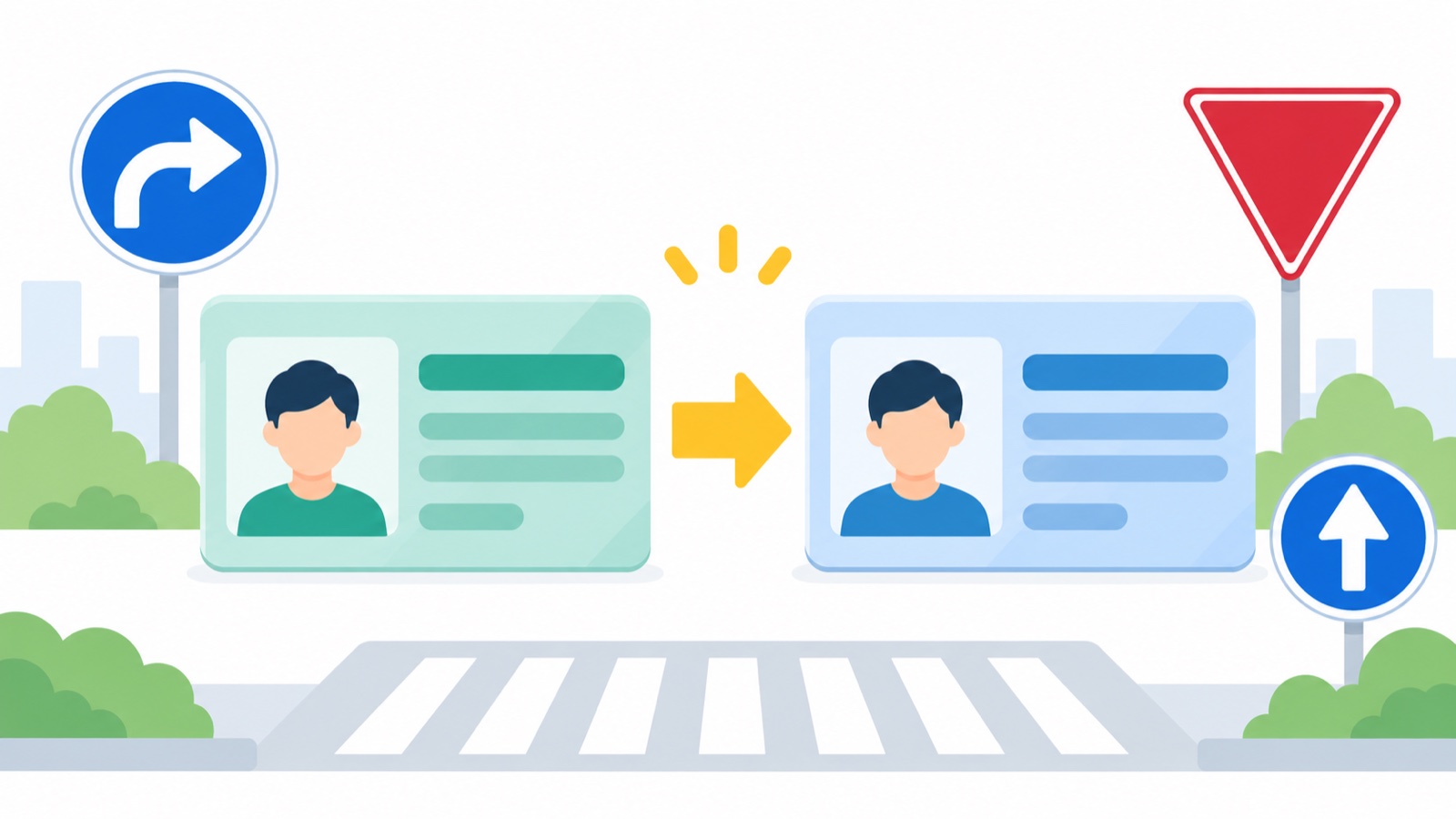
First check whether your country is exempt, then move on to what is tested and how to prepare
If you hold a driver's license from your home country, you can apply to switch it to a Japanese license. This procedure is called gaimen kirikae (foreign license conversion). Most applicants have to take a knowledge confirmation (written test) as part of it.
This test changed significantly on October 1, 2025. The number of questions went from 10 to 50, the passing score went up, and the pass rate has fallen to 42.8%.
This article covers four things:
Whether your country is exempt from the tests (check this first)
What the 50 questions actually cover
Where applicants usually lose points
How to prepare
Note: this information is current as of September 2026. Rules and fees can change. Always confirm with the driver's license center in your prefecture before you apply.
[Check this first] Is your country exempt from the tests?
In the conversion procedure, the knowledge confirmation and the driving skills confirmation may be waived depending on the country that issued your license. Whether you are exempt completely changes what you need to prepare.
The 29 countries and regions exempt from both the knowledge and skills confirmations
Iceland / Ireland / United States (only Ohio, Oregon, Colorado, Virginia, Hawaii, Maryland, and Washington) / United Kingdom / Italy / Australia / Austria / Netherlands / Canada / South Korea / Greece / Switzerland / Sweden / Spain / Slovenia / Czech Republic / Denmark / Germany / New Zealand / Norway / Hungary / Finland / France / Belgium / Poland / Portugal / Monaco / Luxembourg / Taiwan
In addition, licenses from Indiana in the United States are exempt from the skills confirmation only. The knowledge confirmation is still required.
If your license is from a country not on the list
You must take the knowledge confirmation (50 questions).
Licenses from Vietnam, Myanmar, Indonesia, China, Nepal, the Philippines, Thailand, Sri Lanka, Bangladesh, Brazil, Peru, and many other countries are not on the list. Most foreign residents living in Japan fall on the testing side.
👉 The exemptions mainly cover European countries plus South Korea, Taiwan, Australia, and Canada. If your license comes from anywhere else, you will take the 50-question knowledge confirmation.
One more condition: three months in the country that issued your license
There is one condition that applies to everyone, whether your country is exempt or not.
After you got the license, you must have stayed in that country for a total of three months or more.
If you came to Japan soon after getting your license, you may not meet this condition and may not be able to apply. Your stay is verified through entry and exit records in your passport.
[Important] If you are converting to a moped license, there is no skills confirmation
This is easily overlooked. Whether a skills confirmation is required depends on which license category you are applying for.
Converting a standard car or similar license |
Converting to a moped license |
|
Knowledge confirmation (50 questions) |
Required (42.8% pass rate) |
Required (42.8% pass rate) |
Skills confirmation |
Required (13.1% pass rate) |
Not required |
Moped safety course |
— |
Not required |
In other words, if a moped license is all you need, the only hurdle in the conversion route is the 50-question knowledge confirmation. There is no practical driving test, and no moped safety course of the kind required when getting a new moped license at a licensing center.
👉 This matters most if the moped written test is not offered in your language in your prefecture. The moped written test is available in only 1 to 5 languages depending on the prefecture, while the conversion knowledge confirmation is available in 20 languages.
What the knowledge confirmation (50 questions) is like
The October 1, 2025 reform changed the test as follows.
Until September 2025 |
From October 2025 |
|
Questions |
10 |
50 |
Passing score |
7 or more (70%) |
45 or more (90%) |
Question format |
Mostly illustration-based multiple choice |
Mostly written statements |
Knowledge confirmation pass rate |
About 90% |
42.8% |
Skills confirmation pass rate |
About 30% |
13.1% |
The number of questions is five times larger, and the passing score rose from 70% to 90%. Out of 50 questions, you can only miss five.
The test is available in 20 languages: English, Chinese, Korean, Vietnamese, Burmese, Nepali, Indonesian, Thai, Tagalog, Khmer, Mongolian, Sinhala, Hindi, Urdu, Persian, Arabic, Portuguese, Spanish, Russian, and Ukrainian. Being able to take the test in your own language is a real advantage of the conversion route.
A 42.8% pass rate: nearly 6 out of 10 applicants fail
Since the rules were tightened (October to December 2025), the pass rate for the knowledge confirmation has been 42.8%.
That means close to six out of every ten applicants fail. Before the reform, people sometimes said you could pass without studying. That is no longer true.
👉 Years of driving experience in your home country are not enough to pass this test on their own. What is being tested is not your driving skill, but whether you understand Japanese traffic rules accurately.
Before the knowledge confirmation, there is a document review
Conversion is not simply a matter of booking a test. You first book the document review, and only after passing it do you proceed to the knowledge confirmation.
In some prefectures you can take the knowledge confirmation on the same day your documents are approved; in others it falls on a separate day. Check in advance which way your prefecture operates.
Missing paperwork means rejection
If a document is missing or wrong, the application does not go through, and you book again from the start. You never even reach the knowledge confirmation. Prepare carefully.
Your foreign driver's license (still valid)
A Japanese translation of the license — prepared by Zipplus, JAF (Japan Automobile Federation), or another authorized provider
A copy of your certificate of residence (juminhyo) — showing your nationality, residence status, period of stay, and residence card number
Your residence card and passport (older passports may also be required, to verify how long you stayed after getting the license)
One photo — 3 cm x 2.4 cm, taken within the last six months
Since October 2025, a certificate of residence is mandatory. People on short-term stays, who are outside the Basic Resident Registration Act, generally cannot apply, apart from exceptions such as diplomats. Visitors on tourist visas are not eligible.
Zipplus can prepare the Japanese translation of your license
Of all the required documents, the Japanese translation of your driver's license is the one people most often get stuck on, simply because they do not know where to request it. That translation is prepared by Zipplus, the company behind Drivey.
👉 Being turned away over the translation and having to rebook is the most wasteful way to lose time. Arrange it when you start studying, and the document review will not stop you.
What is on the knowledge confirmation
The questions cover the basics of Japanese traffic rules, mainly in these areas:
Traffic lights, signs, and road markings — what each sign tells you to do
Right of way — who goes first at an intersection, and what a priority road is
Driving slowly and stopping completely — where you must slow down, and where you must come to a full stop
No-parking and no-stopping zones — where you may stop, and where you may not
Protecting pedestrians — how to treat pedestrians at crosswalks and railroad crossings
Most questions are written true-or-false statements. Since the illustration-based format is gone, you now need to read the text accurately.
Differences from the rules in your home country are tested
What matters most on this test is the rules that are normal where you come from but different in Japan. Since the reform, the questions concentrate on exactly these gaps.
Japan drives on the left — if you come from a right-hand-traffic country, it is easy to misread the direction of signs and the logic of turns
Pedestrian priority at crosswalks — in Japan you must come to a complete stop before a crosswalk when a pedestrian is about to cross. The rule is not "stop if someone is crossing" but "stop if someone is trying to cross"
At railroad crossings you must stop completely and open your window to check — how railroad crossings are handled varies widely between countries
The concept of "jokou" (driving slowly) — it means moving at a speed that lets you stop immediately. It is not the same as "driving slowly," and questions turn on that difference
👉 The test is designed so that answering from the common sense of your own country gets you the wrong answer. You need to relearn these as Japanese rules.
Watch out for misreading the statements
"Must not" versus "must" — in Japanese, the negative comes at the end of the sentence. If you do not read to the end, the meaning reverses
Exceptions marked by "as a rule" or "however" — miss the exception and you get the question wrong even when your knowledge is correct
Words like "all," "always," and "never" — when a statement is absolute, the question is usually asking whether an exception exists
[Important] This is a different test from the moped written test
This is a common misunderstanding: the knowledge confirmation for license conversion and the written test you take when getting a new license at a license center are two different tests.
Knowledge confirmation (conversion) |
Moped written test |
|
Who takes it |
People who hold a license from home |
Anyone, with or without a license from home |
Questions |
50 |
48 |
Passing score |
45 or more (90%) |
45 points or more (90%) |
Pass rate |
42.8% |
58.7% |
Available languages |
20 languages |
1 to 5, depending on the prefecture |
Moped safety course |
Not required |
Required (Japanese only) |
Bookings |
Two stages: document review and test / 1-3 months in some areas |
One / relatively easy to book |
Both have a 90% passing line and both are mostly written statements, but the questions themselves are different. Studying a moped question book will not prepare you for the conversion test.
👉 Confirm which test you are taking before you start. Get this wrong and your preparation goes to waste.
If you are converting a standard car license, there is also a skills confirmation
If your country is not exempt and you are converting a standard car or similar license, you also take the skills confirmation (an actual driving test). Scoring became stricter in October 2025 as well, and the pass rate fell from about 30% to 13.1%.
Passing through a crosswalk was added to the tasks
Forgetting to signal and turning incorrectly are now scored by the same standard applied to people getting a license for the first time
Crossing railroad tracks is also on the checklist
The longer you have been driving, the more your home-country habits tend to show. The examiner is not asking "can you drive safely?" but "can you drive exactly to the Japanese standard?"
👉 To repeat: if you are converting to a moped license, this skills confirmation does not apply.
Fees (Tokyo, as of September 2026)
Application fee (standard car) |
2,500 yen |
Application fee (moped) |
1,600 yen |
Application fee (large / medium truck) |
3,900 yen |
License issuance fee |
2,350 yen |
Adding another license category |
200 yen |
For a standard car license, expect 2,500 + 2,350 = 4,850 yen. On top of that you pay for the translation and for issuing your certificate of residence. If you fail, you pay the application fee again.
In some areas the wait is one to three months
Since the reform, more people are taking and retaking the test, so in some areas the knowledge confirmation is booked up one to three months in advance.
👉 If you fail, you go back and book again from scratch. Passing on the first try is what protects that time.
In Tokyo you can apply at the Fuchu, Samezu, and Koto test centers. Note that the Koto center only handles licenses from the 29 exempt countries and regions. Bookings are made by phone or through the Metropolitan Police Department's online procedure portal.
Frequently asked questions
Q. Where can I get past questions for the knowledge confirmation?
There is no officially published set of past questions. However, the test covers the basics of Japanese traffic rules — lights and signs, right of way, driving slowly and stopping, no-parking rules, and pedestrian protection — so practicing that range in true-or-false written form is the preparation that works. Practicing in the same format as the real test reduces the points you lose to misreading.
Q. I have driven for 20 years at home. Do I still need to study?
Yes. The pass rate is 42.8%, and most people taking the test already have driving experience at home. Nearly 60% of them still fail. The test asks about knowledge of Japanese traffic rules rather than driving skill, and the passing line is a demanding 90%.
Q. What languages can I take it in?
The knowledge confirmation is available in 20 languages, including Vietnamese, Burmese, Indonesian, Chinese, Nepali, Thai, and Tagalog. Tell the counter which language you want when you apply.
Q. If I only want a moped license, do I still need the skills confirmation?
No. When you apply for a moped license, the skills confirmation is waived. There is no moped safety course either. Pass the 50-question knowledge confirmation and you can get the license.
Q. What happens if I fail?
You can take it again. However, you pay the application fee again and you have to book again. In some areas the next available slot is one to three months away, which delays everything considerably.
Q. Can I convert my license on a short-term (tourist) visa?
No. Since October 2025 a certificate of residence has been mandatory, and short-term visitors outside the Basic Resident Registration Act generally cannot apply, apart from exceptions such as diplomats.
Q. I came to Japan right after getting my license. Can I convert it?
You must have stayed in that country for a total of three months or more after getting the license. If you do not meet that, you cannot apply. Your stay is verified through entry and exit records in your passport.
How to start preparing
To summarize what the reformed knowledge confirmation looks like:
50 questions, passing line 90% (you can only miss five)
Pass rate 42.8% — nearly 60% fail
Mostly written statements, so reading comprehension matters
Differences from your home country's rules are tested heavily
This is not a test you pass on driving experience alone.
When you prepare, keep these three things in mind.
Start from the differences with your home country's rules — driving on the left, stopping at crosswalks, checking at railroad crossings, what "driving slowly" means. This is where most points are lost
Understand the meaning in your own language — if you start by memorizing Japanese sentences, a small change in wording will trip you up. Understanding why a rule exists, in your own language, lets you handle questions you have never seen
Practice with true-or-false written questions — getting used to the real format reduces the points you lose to misreading
You can start before you come to Japan
What is tested is knowledge of Japanese traffic rules, so you can study this before arriving. If you only start looking for materials after entering Japan, your test date slips accordingly. With an online learning environment, you can begin while you are still in your home country.
Drivey has a course built for license conversion
The knowledge confirmation for license conversion is a different test from the moped or standard car written test. Drivey has a dedicated course for the license conversion knowledge confirmation.
What Drivey offers:
A license conversion course — practice built around the 50-question knowledge confirmation. It is separate from the moped, provisional, and standard car courses, so you only study the questions for the test you are actually taking
Six languages — Japanese, English, Vietnamese, Burmese, Indonesian, and Chinese. You can understand what Japanese traffic rules mean in your own language before you sit the test
The same true-or-false written format as the real test — practicing in the actual format cuts down the points lost to misreading
Videos and Q&A texts — situations that are hard to grasp from text alone, such as stopping at a crosswalk or crossing railroad tracks, can be checked visually
Japanese with furigana — if you take the test in Japanese, you can study without getting stuck on kanji
Zipplus, the company that operates Drivey, also prepares the Japanese translation of your driver's license that you need for the application. You can handle studying and paperwork in one place.
With a 42.8% pass rate, and with failure costing you one to three months while you wait for a new booking, the quality of your preparation directly determines when you get your license. Pass the first time and you spend no extra money and no extra months.
Summary
First check whether your country is exempt. 29 countries and regions are exempt, mainly European countries plus South Korea, Taiwan, Australia, and Canada. Vietnam, Myanmar, Indonesia, China, Nepal and others are not
You must have stayed in the issuing country for a total of three months or more after getting the license
The knowledge confirmation is 50 questions, with 45 or more to pass (90%), at a 42.8% pass rate. It changed from 10 questions and 70% in October 2025
If you are converting to a moped license, there is no skills confirmation and no safety course. The only hurdle is the 50-question knowledge confirmation (for standard car conversions, the skills confirmation is 13.1%)
A document review comes before the test and also requires a booking. Missing paperwork means rejection. Zipplus can prepare the translation
Questions cover lights and signs, right of way, driving slowly and stopping, no-parking rules, and pedestrian protection, concentrating on differences from your home country
It is a different test from the moped written test. The moped test has a 58.7% pass rate but is available in only 1 to 5 languages and requires the safety course
The knowledge confirmation is available in 20 languages, so you can most likely take it in your own language
In Tokyo the cost is about 4,850 yen for a standard car license. A certificate of residence has been mandatory since October 2025, so short-term visitors are not eligible
In some areas bookings are one to three months out, and failing means booking again
Rules, fees, and the list of exempt countries can change. This article is current as of September 2026. Confirm the latest information with the driver's license center in your prefecture before you apply.
Sources: National Police Agency figures for October-December 2025 on foreign license conversion (knowledge confirmation 42.8%, skills confirmation 13.1%) / National Police Agency, "Driver's License Statistics 2025" (moped written test: 162,668 examinees, 95,495 passes, 58.7% pass rate) / Tokyo Metropolitan Police Department, "Converting a driver's license obtained overseas into a Japanese driver's license" / Tokyo Metropolitan Police Department, "Written tests available in foreign languages" (updated 11 May 2026) / Fukuoka Prefectural Police, "Converting a foreign driver's license" (no skills confirmation required for moped applications)
![License Conversion Practice Questions | 21 Practice Questions with Answers for the 50-Question Knowledge Test [2026 Edition]](/_vercel/image?url=https:%2F%2Feswsspetwnfjmwiiduvc.supabase.co%2Fstorage%2Fv1%2Fobject%2Fpublic%2Fblog-images%2Fblogs%2F1789304570902.jpg&w=1536&q=100)
![Moped Licenses for Technical Intern Trainees and Specified Skilled Workers | Securing a Commute for Supervising Organizations and Registered Support Organizations, and the Route Available in Their Native Language [2026 Edition]](/_vercel/image?url=https:%2F%2Feswsspetwnfjmwiiduvc.supabase.co%2Fstorage%2Fv1%2Fobject%2Fpublic%2Fblog-images%2Fblogs%2F1789305380445.png&w=1536&q=100)
![How to Support Foreign Residents in Getting a Moped License: Methods, Reservations, and Preparation in Kanagawa Prefecture [For Employers and Supporters]](/_vercel/image?url=https:%2F%2Feswsspetwnfjmwiiduvc.supabase.co%2Fstorage%2Fv1%2Fobject%2Fpublic%2Fblog-images%2Fblogs%2F1789078192518.png&w=1536&q=100)