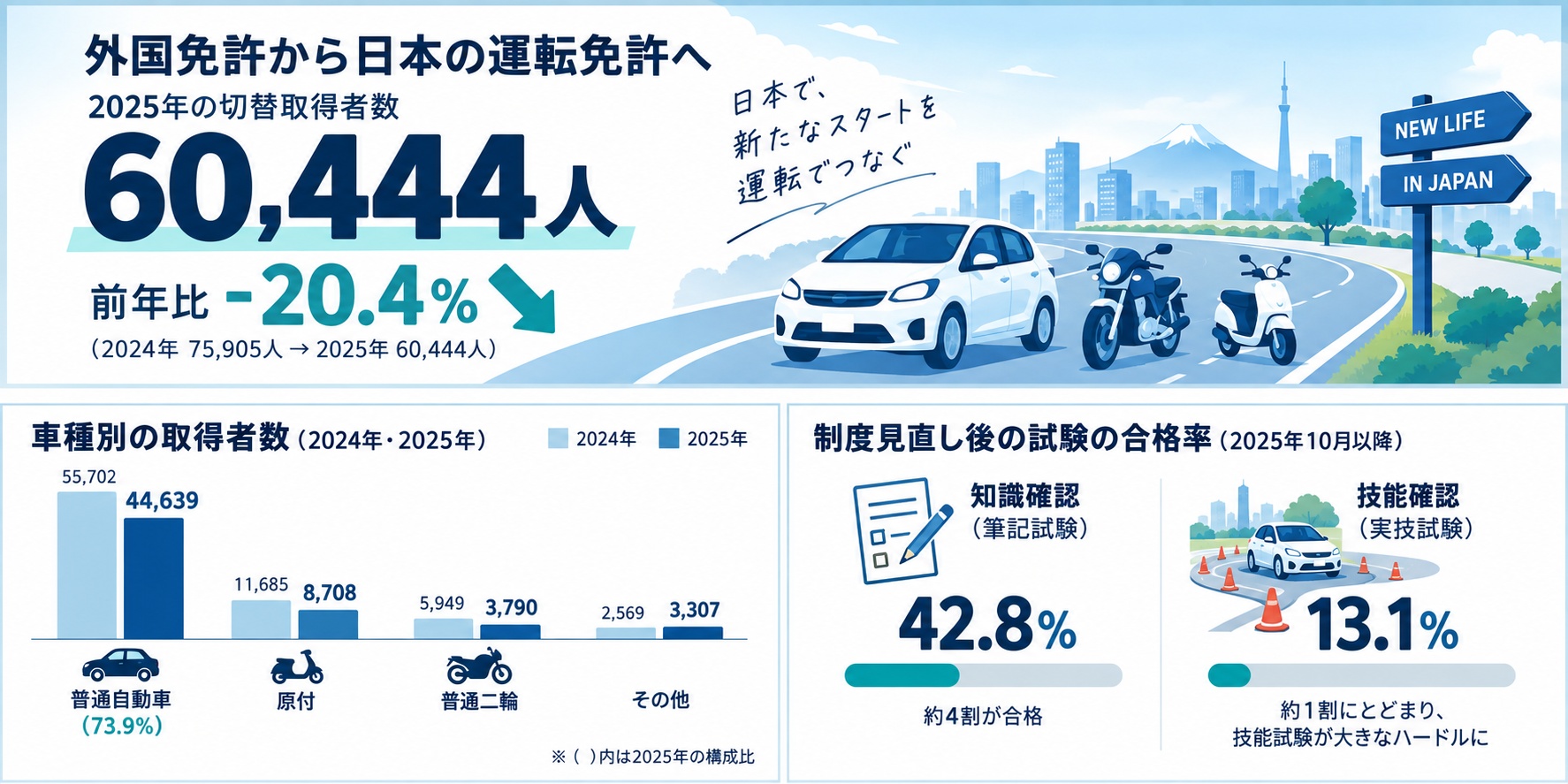
In 2025, 60,444 people obtained a Japanese driver's license by converting a foreign license (license conversion, or gaimen kirikae). That is 20.4% fewer than the 75,905 of the previous year. The breakdown is 44,639 regular licenses (73.9%), 8,708 moped licenses (14.4%), and 3,790 regular motorcycle licenses (6.3%). Class 2 licenses: zero.
The decline was not even. Four-wheel licenses fell 17.1%, while two-wheel licenses fell 30.1%. The drop is concentrated in two-wheelers.
The key to explaining this drop is not the knowledge test but the driving skills test. After the October 2025 rule change, the knowledge test pass rate fell to 42.8%, but the driving skills test pass rate was 13.1%. A license is issued only when both are passed, so for license types that require both, the pass-through rate has fallen to 5.6%. The driving skills test was already the narrowest gate before the change.
This article is for people who handle the hiring of foreign workers — supervising organizations, registered support organizations, company HR departments, and newspaper delivery offices. Using National Police Agency statistics, it sets out how large license conversion is and which licenses it is used for.
👉 If you are the one going through license conversion yourself, see our article on the license conversion procedure and how to prepare. It explains the required documents, the fees, and the content of the knowledge test from the test taker's point of view.
* The number of license holders comes from the "Foreign license converters" column in "(i) Breakdown of those who passed driver's license tests" in the National Police Agency's Driver's License Statistics. The 2025 (Reiwa 7) figures are from page 25 of the Reiwa 7 edition, and the 2024 (Reiwa 6) figures are from page 24 of the Reiwa 6 edition. Note that the editions differ. The pass rates are the figures the National Police Agency released on March 2, 2026, and can be checked in a Nikkei report.
How many people get a license through license conversion each year
In 2025, the number was 60,444. This is the number of people who converted a license obtained abroad into a Japanese license and had it issued. It is 15,461 (20.4%) fewer than the year before.
60,444 People who got a license through | −20.4% Year on year |
2025 | 2024 | |
|---|---|---|
License holders through license conversion | 60,444 | 75,905 |
Of which Class 1 licenses | 60,444 | 75,905 |
Of which Class 2 licenses | 0 | 0 |
Change from previous year | −15,461 (−20.4%) | — |
In the Driver's License Statistics, this number is counted as part of those who "passed with the written test and driving test waived." In license conversion, applicants do not take the same written test and driving test that Japanese applicants take. Instead, they go through separate procedures called the knowledge test and the driving skills test, so in the statistics they are classified as "waived."
👉 These 60,444 are the people who "passed and received a license." People who failed are not included. The total number of attempts at the knowledge test and the driving skills test is much higher than this.
Which licenses are people converting to
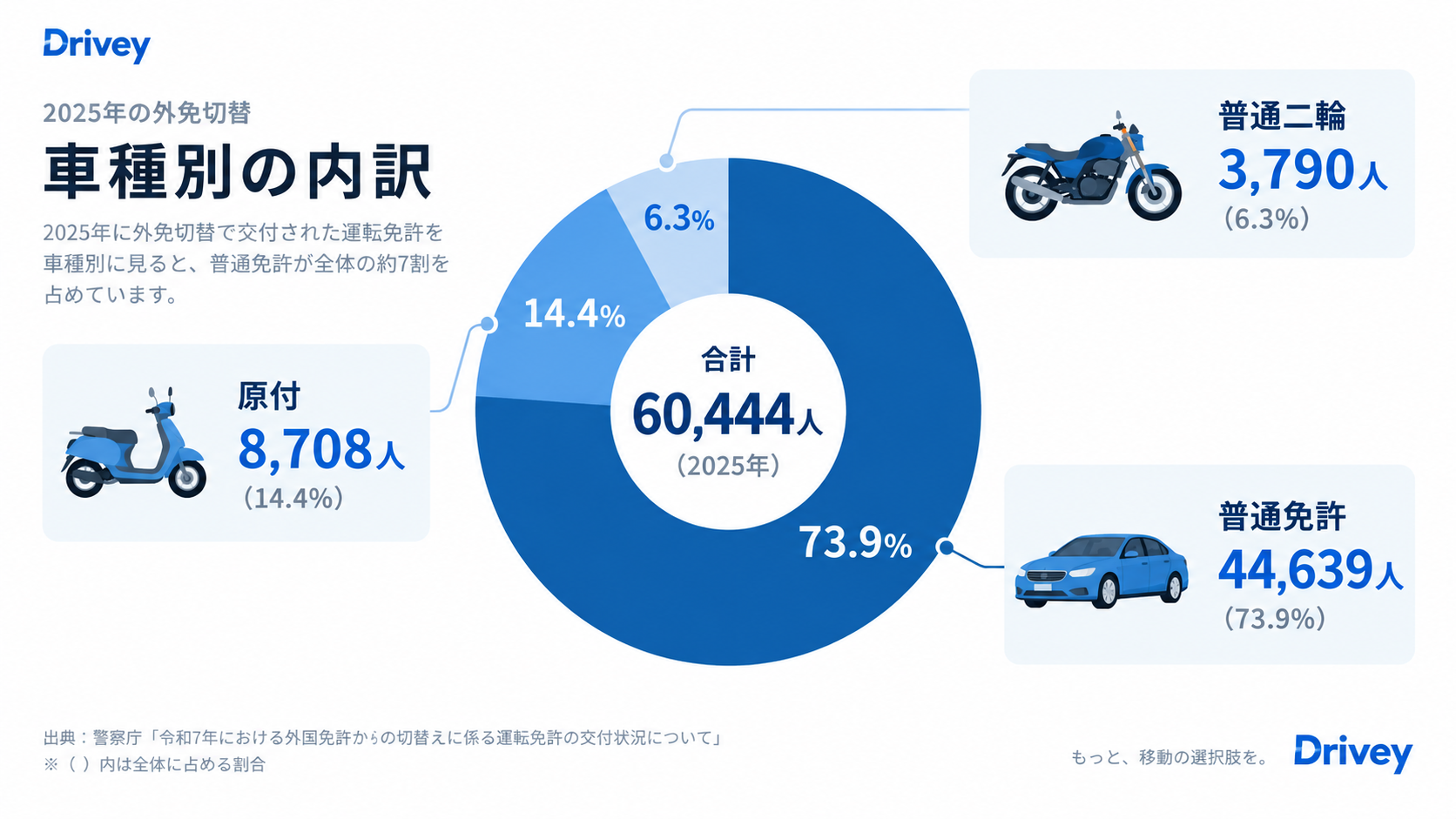
The breakdown by license type and the change from the previous year are as follows.
License type | 2025 | 2024 | Change | Share |
|---|---|---|---|---|
Regular | 44,639 | 54,054 | −17.4% | 73.9% |
Of which automatic only (subset) | 27,924 | 35,548 | −21.4% | 62.6% of regular |
Moped | 8,708 | 11,657 | −25.3% | 14.4% |
Regular motorcycle | 3,790 | 6,071 | −37.6% | 6.3% |
Of which small-size only (subset) | 3,227 | 5,235 | −38.4% | 85.1% of regular motorcycle |
Of which automatic small-size only (subset) | 2,474 | 3,345 | −26.0% | 76.7% of small-size only |
Semi-medium | 1,835 | 2,036 | −9.9% | 3.0% |
Large motorcycle | 870 | 1,401 | −37.9% | 1.4% |
Large | 395 | 406 | −2.7% | 0.7% |
Medium | 185 | 243 | −23.9% | 0.3% |
Towing | 18 | 30 | −40.0% | 0.03% |
Large special | 4 | 7 | −42.9% | 0.01% |
Small special | 0 | 0 | — | — |
Class 2 licenses (all categories) | 0 | 0 | — | — |
Total | 60,444 | 75,905 | −20.4% | 100% |
* "Automatic only," "small-size only," and "automatic small-size only" are each subsets of the category above them. They are not counted twice in the total. Shares and rates of change are rounded.
70% are regular licenses, and over 60% of those are automatic only
Regular licenses number 44,639, or 73.9% of the total. Four-wheel licenses (large, medium, semi-medium, and regular) together number 47,054, or 77.8% of the total.
Of the regular licenses, 27,924 (62.6%) are automatic only. A little over 60% of foreign workers who will drive in Japan do not drive manual cars. This figure bears directly on choosing company vehicles and planning work assignments.
The decline is concentrated in two-wheelers
This is the most striking point in the 2025 figures. While the total fell 20.4%, only the drop in two-wheelers stands out.
2025 | 2024 | Change | |
|---|---|---|---|
Four-wheel (large, medium, semi-medium, regular) | 47,054 | 56,739 | −17.1% |
Two-wheel (large motorcycle, regular motorcycle, moped) | 13,368 | 19,129 | −30.1% |
Of which 125cc or less (moped + small-size only) | 11,935 | 16,892 | −29.3% |
The rate of decline for two-wheelers is 13.0 percentage points larger than for four-wheelers. In particular, regular motorcycle fell 37.6% and large motorcycle fell 37.9%, close to a 40% drop.
The share of two-wheelers in the total also fell, from 25.2% the year before to 22.1%.
Class 2 licenses cannot be obtained through license conversion
Class 2 licenses, such as those for taxis and buses, cannot be obtained through license conversion. In the statistics too, the foreign license converters column shows "—" for every Class 2 category (large Class 2, medium Class 2, regular Class 2, large special Class 2, towing Class 2), and not a single person is counted in either 2025 or 2024.
The license conversion fee table published by the Tokyo Metropolitan Police Department also lists only Class 1 categories, such as regular, moped, large, medium, and semi-medium.
👉 For a foreign driver to drive a taxi or bus, they need to take the Class 2 license test in Japan. Eligibility and test content are covered in our article explaining the Class 2 license written exam.
Why the drop in two-wheelers is so large
The statistics themselves do not show the reason. But when you lay the structure of the tests over them, a consistent explanation emerges. There are two factors, and the larger one is the driving skills test.
1. Whether a driving skills test is required creates a gap even within two-wheelers
In license conversion, only conversion to a moped license is exempt from the driving skills test. Regular motorcycle, large motorcycle, and all four-wheel licenses require the driving skills test.
This difference shows up directly as a difference in the rate of decline.
License type | Driving skills test | 2025 | 2024 | Change |
|---|---|---|---|---|
Moped | Not required | 8,708 | 11,657 | −25.3% |
Regular motorcycle (small-size only) | Required | 3,227 | 5,235 | −38.4% |
Regular motorcycle (all) | Required | 3,790 | 6,071 | −37.6% |
Large motorcycle | Required | 870 | 1,401 | −37.9% |
👉 Moped, which does not require the driving skills test, fell 25.3%. Small-size only, which does, fell 38.4%. The gap is 13.1 percentage points.
However, this whole gap cannot be attributed to the driving skills test. From April 1, 2025, the "new-standard moped" rule took effect: vehicles with a total displacement of 125cc or less, with maximum output limited to 4.0 kW or less, can now be ridden on a moped license. The background is the end of production of 50cc mopeds due to stricter emission standards at the end of October 2025.
In other words, during 2025 the range of vehicles a moped license covers itself expanded. This pushes mopeds up and small-size only down. The stricter tests took effect in October and the new-standard moped rule in April, so a year-on-year comparison mixes both. The effect of the driving skills test alone cannot be isolated.
That the driving skills test is the narrowest gate can be said from the 13.1% pass rate itself. But the difference in decline rates between license types cannot be used as evidence for it.
2. The other factor is the mix of exempt countries
In license conversion, the knowledge test and the driving skills test are waived depending on the country that issued the license. 29 countries and regions qualify, including South Korea, Taiwan, France, Germany, the United Kingdom, and Australia (Tokyo Metropolitan Police Department).
All 29 of these countries and regions have well-established car licensing systems. People who hold a license there have almost no reason to go out of their way to convert to a moped or small motorcycle license. Most conversions from exempt countries are likely four-wheel licenses.
On the other hand, Vietnam, Myanmar, Indonesia, China, Nepal, the Philippines, Thailand, and other countries that send many workers to Japan are all outside the exemption. Conversions to moped and small motorcycle licenses come mainly from this group.
👉 In other words, four-wheel licenses include a certain number of "people who take no test at all." The drop in regular licenses stayed at 17.4% most likely because this group props it up. Two-wheelers have no such support.
Putting these two together, the 2025 figures can be read like this. Two-wheelers as a whole fell sharply because they lack the support of exempt countries. And within two-wheelers, the categories that require the driving skills test fell especially sharply because the driving skills test is the narrowest gate. However, as noted above, the gap between moped and small-size only also includes the effect of the new-standard moped rule. This is only a reading derived from the statistics, not a separation of how large each effect is.
What changed with the October 2025 rule change
On October 1, 2025, both the knowledge test and the driving skills test became stricter. The figure of 60,444 covers one full year: 9 months before the change and 3 months after it.
Knowledge test: from 10 questions at 70% to 50 questions at 90%
Until September 2025 | From October 2025 | |
|---|---|---|
Number of questions | 10 | 50 |
Pass mark | 70% | 90% (45 or more correct) |
Illustration questions | Yes | Abolished (all text questions) |
Sessions per day | Morning and afternoon | One afternoon session only |
The number of questions, pass mark, abolition of illustration questions, and number of sessions are based on the Tokyo Metropolitan Police Department's notice on the revised Enforcement Regulations of the Road Traffic Act, effective October 1, 2025.
Driving skills test: 13.1% pass rate, and already the narrowest gate before the change
This is easy to overlook, but the knowledge test was not the only thing that got stricter. In the driving skills test, tasks such as passing pedestrian crossings, signaling and safety checks when turning, stopping at stop signs, the procedure for changing lanes, and crossing railway crossings were added or made stricter.
Putting the pass rates side by side makes it clear which one is the gate.
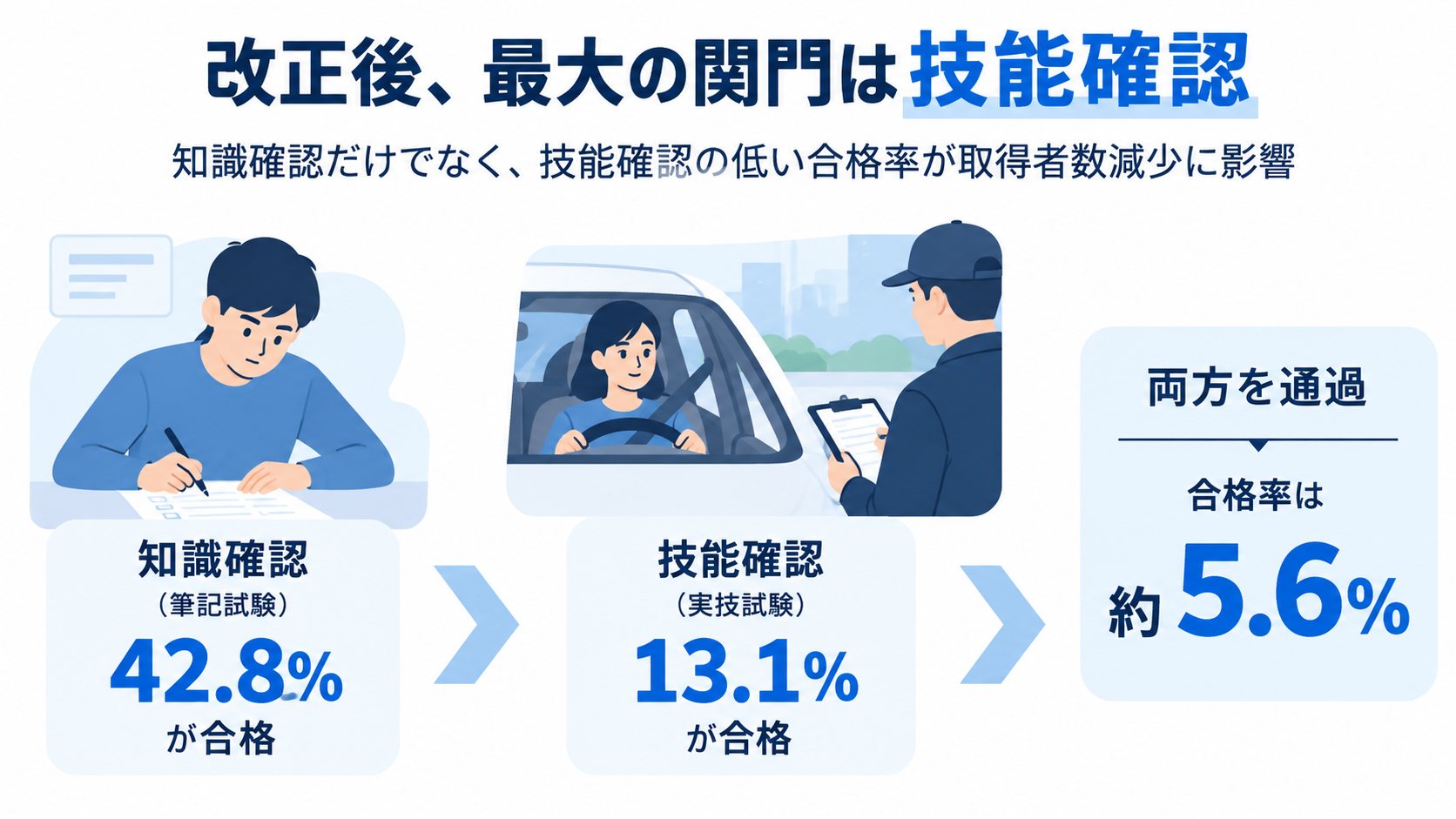
2024 (before the change) | October–December 2025 | Change | |
|---|---|---|---|
Knowledge test | 92.5% | 42.8% | About 54% lower |
Driving skills test | 30.4% | 13.1% | About 57% lower |
Share passing both (multiplied) | About 28.1% | About 5.6% | About one-fifth |
Moped (knowledge test only) | 92.5% | 42.8% | About half |
* The pass rates for the knowledge test and the driving skills test are the figures the National Police Agency released on March 2, 2026 (Nikkei report). The "share passing both" is a reference value this article calculated by multiplying the two pass rates. It was not published by the National Police Agency.
* This figure is the share of people who take each test once and pass both on the first try. Both the knowledge test and the driving skills test can be retaken, so the final rate of obtaining a license after multiple attempts is higher than this.
* In addition, the two pass rates do not track the same group of people. There is a booking wait between passing the knowledge test and taking the driving skills test, so most people who took the driving skills test in October–December 2025 are likely to have passed the old knowledge test (92.5% pass rate). Once the new standard settles in, the people taking the driving skills test will be those who got through the 42.8%, so its pass rate may rise above 13.1%. Treat about 5.6% as a rough figure close to the lower limit.
👉 Before the change, the knowledge test was a procedure that 92.5% of people passed. The real gate was the driving skills test at 30.4%. That relationship has not changed after the rule change: 42.8% for the knowledge test against 13.1% for the driving skills test. The driving skills test is more than three times narrower.
Therefore, for conversion to regular, regular motorcycle, large motorcycle, semi-medium, and similar licenses, the focus of preparation should be on the driving skills test. Preparing only for the knowledge test will not move the pass-through rate much above 5.6%.
2026 will be the first year with a full year of impact
The 60,444 figure for 2025 reflects the new standard for only 3 of the 12 months. Even so, it was 20.4% lower than the year before.
The rule change did more than lower pass rates. The number of sessions per day was cut from two, morning and afternoon, to one in the afternoon. The number of people who can be accepted was reduced, and at the same time more people are retaking the test. In some areas, bookings for document screening and the knowledge test are full 1–3 months ahead.
👉 2026 is the first year the rule change applies for the full year. Whether the number of license holders falls further or recovers as preparation improves will be confirmed in the next statistics, due to be published in mid-2027.
How employers can use these figures
In practical terms, there are four takeaways.
1. The moped route is currently the easiest to get through
8,708 moped licenses and 3,790 regular motorcycle licenses including small-size only show that converting to a two-wheel license is not an unusual choice.
Among these, only the moped license requires neither the driving skills test nor the moped training course. The only gate is the 50-question knowledge test, with a 42.8% pass rate. That is more than 7 times the 5.6% for license types that require both tests.
👉 If the goal is to secure a way to commute, it is worth first considering whether a moped is enough. For this group, the gate is narrowed down to the knowledge test alone, so advance study translates directly into results.
2. The driving skills test needs separate preparation from the knowledge test
A 13.1% pass rate cannot be reached just by reading study materials. The driving skills test is taken in a real car, and what is checked are actions such as "Did you go slow (jokou) when approaching a pedestrian crossing?", "Did you signal and visually check when turning?", and "Did you stop at the railway crossing and look both ways?"
The reason people stumble is often not driving skill itself. In their home countries, the timing of signals and the order of safety checks are different. The longer someone has been driving, the more their home country's habits are ingrained, and the more they diverge from Japan's scoring criteria.
👉 Plan study for the knowledge test and preparation for the driving skills test separately. Repeated study in the native language works for the knowledge test, but the driving skills test requires practice in a real car and understanding Japan's scoring criteria through video.
As one option, ZIPLUS Co., Ltd., which operates Drivey, offers the License Conversion Anshin Package. It combines issuing the translation, a textbook in a foreign language, videos for driving skills test preparation, and one-on-one practical lessons at a driving school. The driving skills test videos are also offered on their own as SAMURAI DRIVER: 10 videos of about 5 minutes each, covering the 9 test tasks and a mock test drive modeled on the real test. They are available in 4 languages — Japanese, English, Chinese, and Vietnamese — for 11,000 yen with a 1-year viewing period.
* The published pass-rate results are 77.7% for those who completed the Anshin Package curriculum and 70.5% for SAMURAI DRIVER viewers. However, both are results from before the October 2025 rule change and cannot be compared directly with the post-change 13.1%. Please check the latest results with the provider.
3. The lead time to count back from the start date is getting longer
After the rule change, you need to factor in both the pass rates — 13.1% for the driving skills test and 42.8% for the knowledge test — and a booking wait of 1–3 months. For license types that require the driving skills test, a plan that assumes passing on the first attempt does not hold up. An approach of "starting preparation after arrival in Japan" makes the start of work impossible to predict.
4. A Class 2 license requires a separate plan
In the taxi and bus industries, license conversion cannot get a driver to a Class 2 license. It is a two-stage process: obtain a Class 1 license, then have the driver take the Class 2 test in Japan. The eligibility requirement of being 21 or older with a total of 3 or more years of license history also affects hiring plans.
👉 Material for deciding which license your organization should aim for is in our article comparing routes to a moped license. Differences in test languages by prefecture can be checked in our article covering all 47 prefectures.
Frequently asked questions
Q. Is 60,444 the number of test takers or the number who passed?
It is the number of people who passed and had a license issued. It is the figure counted in "Breakdown of those who passed driver's license tests" in the Driver's License Statistics, so people who failed are not included. The total number of attempts at the knowledge test and the driving skills test is much higher than this.
Q. Is the 20.4% drop from the previous year because of the rule change?
The statistics alone cannot confirm cause and effect. However, the new standard applied for only 3 of the 12 months, and in those 3 months the knowledge test pass rate fell from 92.5% to 42.8% and the driving skills test from 30.4% to 13.1%. The pass-through rate for license types that require both went from about 28.1% to about 5.6%. The fact that the decline is larger for license types that require the driving skills test is also consistent with reading it as an effect of the rule change.
Q. Which is harder, the knowledge test or the driving skills test?
The driving skills test. In October–December 2025, the pass rate was 42.8% for the knowledge test against 13.1% for the driving skills test, a gap of more than three times. Before the change, in 2024, it was also 92.5% for the knowledge test and 30.4% for the driving skills test, so the driving skills test was the narrower gate then too. Preparing only for the knowledge test is not enough. However, conversion to a moped license alone is exempt from the driving skills test, so preparation for the knowledge test directly decides the result.
Q. Did all 60,444 people take the knowledge test?
No. When converting from one of 29 countries and regions such as South Korea, Taiwan, France, and Germany, both the knowledge test and the driving skills test are waived. However, Vietnam, Myanmar, Indonesia, China, Nepal, and other countries that send many workers to Japan are all outside the exemption.
Q. Can a Class 2 license be obtained through license conversion?
No. Only Class 1 licenses can be obtained through license conversion. In the statistics too, not a single Class 2 conversion is counted in either 2025 or 2024, and the Tokyo Metropolitan Police Department's fee table lists only Class 1 categories.
Q. What is the advantage of getting a moped license through license conversion?
Neither the driving skills test nor the moped training course is required. Not having to take the driving skills test, with its 13.1% pass rate, is currently the biggest advantage. When getting a new moped license at a driver's license center, the moped training course, held in Japanese, is mandatory, but license conversion does not require it either. However, the knowledge test covers the same 50 questions as conversion to a regular license, not questions specific to mopeds.
Q. When will the 2026 figures be known?
They are expected to be published in mid-2027. The Reiwa 7 edition was published on June 24, 2026, and the Reiwa 6 edition on May 9, 2025. The next edition, Reiwa 8, will be the first to reflect a full year of the rule change.
Q. Where can I see the source data for these figures?
Both PDF and Excel versions are available from the Driver's License Statistics page on the National Police Agency website. This article cites the "Foreign license converters" column in "(i) Breakdown of those who passed driver's license tests": the 2025 figures are on page 25 of the Reiwa 7 edition, and the 2024 figures are on page 24 of the Reiwa 6 edition. Note that the editions differ. Page 24 of the Reiwa 7 edition is a different table, "(a) Year-on-year comparison of driver's license test takers and passers." The pass rates are not posted on the National Police Agency website.
Summary
In 2025, 60,444 people obtained a Japanese license through license conversion, down 20.4% from 75,905 the year before. All were Class 1 licenses
The main cause of the decline is the driving skills test. In October–December 2025, the pass rate was 42.8% for the knowledge test against 13.1% for the driving skills test. Before the change, in 2024, it was 92.5% against 30.4%, so the driving skills test has consistently been the narrowest gate
For license types that require passing both, the pass-through rate went from about 28.1% to about 5.6%. For mopeds, which require only the knowledge test, it went from 92.5% to 42.8%, a different size of drop
Moped, which does not require the driving skills test, fell 25.3%, while small-size only, which does, fell 38.4%, a gap of 13.1 percentage points. However, the effect of the new-standard moped rule effective April 2025 (vehicles of 125cc or less with maximum output of 4.0 kW or less can be ridden on a moped license) is also mixed in, so this gap cannot be seen as the effect of the driving skills test alone
Regular licenses number 44,639 (73.9%). Of these, 27,924 (62.6%) are automatic only
Class 2 licenses cannot be obtained through license conversion. Zero were counted in both 2025 and 2024
The new standard applied for only 3 of the 12 months. Even so, the number fell 20.4%. 2026 will be the first year the rule change applies for the full year
License conversion is a system used by some 60,000 people a year. And from October 2025, it became a procedure where advance preparation decides the result. The driving skills test in particular cannot be passed with knowledge alone.
👉 Ways to handle license conversion preparation for your employees as a group are set out on our corporate services page. We offer a license conversion course and a moped license course that can be studied in the native language, and each person's progress can be checked on the admin screen. For a quote or a demo, please use the contact form.
Talk to us about setup and pricing We will explain options for the number of users, supported languages, admin features, and contract terms. A demo is also available. Contact us / Get a quoteCorporate plan details Talk to us by phone |
Sources: The number of license holders is from the "Foreign license converters" column in "(i) Breakdown of those who passed driver's license tests" in the National Police Agency's Driver's License Statistics. The 2025 figures are from page 25 of the Reiwa 7 edition (published June 24, 2026), and the 2024 figures are from page 24 of the Reiwa 6 edition (published May 9, 2025). An Excel version is also available from the Driver's License Statistics page / The pass rates are the figures the National Police Agency released on March 2, 2026 (2024: knowledge test 92.5%, driving skills test 30.4%; October–December 2025: knowledge test 42.8%, driving skills test 13.1%). They are not posted on the National Police Agency website, so please refer to the Nikkei report / Tokyo Metropolitan Police Department, "Converting a driver's license obtained abroad into a Japanese driver's license" (the 29 exempt countries and regions, fees, required documents) / Tokyo Metropolitan Police Department, "Revised Enforcement Regulations of the Road Traffic Act effective October 1, 2025" (knowledge test of 50 questions with 45 or more correct required, abolition of illustration questions, added driving skills test tasks) / The new-standard moped rule is from the revised Enforcement Regulations of the Road Traffic Act effective April 1, 2025 (two-wheelers with a total displacement of 125cc or less and maximum output of 4.0 kW or less are treated as Class 1 mopeds). This article is for informational purposes and does not assume the use of any particular service.